Cover image

EMAzing Trends: When One Moving Average Beats a Basket of Signals

EMAzing Trends: When One Moving Average Beats a Basket of Signals The latest research from Sebastien Valeyre delivers a surprise to the CTA world: a single exponential moving average (EMA) can match — or even beat — the performance of elaborate, multi-indicator trend-following systems. This conclusion comes from an empirical validation of a 2014 theoretical model by Grebenkov & Serror, which predicted the optimal Sharpe ratio for an EMA-based trend strategy given market autocorrelation and trend strength. Unlike the industry’s love affair with blending MACDs, crossovers, momentum mixes, and Bollinger Bands, the data suggest that simplicity wins. ...
August 10, 2025 · 3 min · Zelina
Cover image

Market’s Inner Circle: Finding Balance in Stock Networks

When financial markets move in unison, the patterns are rarely random. Beneath the noise of daily price changes, certain groups of stocks form tightly knit clusters—connected not just by strong correlations, but by relationships that remain structurally stable over time. The recent Finding Core Balanced Modules in Statistically Validated Stock Networks paper formalizes this idea through the Largest Strong-Correlation Balanced Module (LSCBM) framework. Why Traditional Stock Networks Fall Short Most stock network studies use a simple recipe: calculate correlations, set a threshold (say 0.7), and keep only edges above it. This approach is quick—but flawed: ...

August 10, 2025 · 3 min · Zelina
Cover image

Taming the Trading Floor: How 'Roaree' Optimizers Could Redefine AI Stock Forecasting

When financial AI meets the optimizer arms race, the stakes are measured in both milliseconds and market moves. The recent From Rattle to Roar study tests this premise with MambaStock — a selective state-space model — trained to forecast S&P 500 weekly returns. The twist: pitting eight widely-used optimizers against a new family called Roaree, designed to capture Lion’s speed while taming its instability. Why Optimizers Matter More in Finance Than You Think In financial forecasting, milliseconds can mean the difference between execution and regret. This makes optimizer choice not just a theoretical concern but a practical lever for profitability. The study reinforces that adaptive-rate, momentum-based methods (Adam, RMSProp, Nesterov) deliver the lowest test errors for noisy, small-magnitude financial returns. Vanilla SGD struggles in this regime; AdamW’s decoupled weight decay over-regularizes, slowing convergence in already weak-signal environments. ...

August 10, 2025 · 3 min · Zelina
Cover image

The Silent Skill Drain: How Entry-Level AI Automation Threatens Future Growth

A Hidden Cost of AI Efficiency When AI takes over routine tasks, companies often see immediate productivity gains. Senior staff can accomplish more without relying on juniors, costs go down, and short-term profits rise. But beneath these benefits lies a risk that most boardrooms overlook: the erosion of tacit knowledge—the hands-on expertise that only develops through years of guided practice. Tacit skills aren’t in manuals or knowledge bases. They’re the intuition of a surgeon who adapts mid-procedure, the judgment of a lawyer during negotiations, the troubleshooting instincts of an engineer. These skills pass from experts to novices mainly through direct collaboration on real work. Remove the entry-level work, and you cut the ladder that builds tomorrow’s experts. ...

August 10, 2025 · 3 min · Zelina
Cover image

When Volatility Travels: Mapping Global Spillovers with Rough Multivariate Models

Most volatility models live in a one-dimensional world. They chart the ups and downs of a single market’s risk, ignoring the complex web of connections across global exchanges. But in practice, volatility is a frequent flyer — shocks in New York can ripple into London, Frankfurt, and beyond within hours. The paper Multivariate Rough Volatility takes a decisive step toward modelling this interconnected reality. ...

August 10, 2025 · 3 min · Zelina
Cover image

From Black Box to Glass Box: DeepVIS Makes Data Visualization Explain Itself

When business leaders ask for a “quick chart,” they rarely expect to become detectives in the aftermath—trying to work out why the AI picked that chart type, grouped the data that way, or left out important categories. Yet that’s exactly the frustration with most Natural Language to Visualization (NL2VIS) tools today: they generate results like a magician pulling a rabbit from a hat, with no insight into how the trick was done. ...

August 9, 2025 · 3 min · Zelina
Cover image

From Chaos to Choreography: The Future of Agent Workflows

In the world of Large Language Model (LLM)-powered automation, agents are no longer experimental curiosities — they’re becoming the operational backbone for scalable, autonomous AI systems. But as the number and complexity of these agents grow, the missing piece is no longer raw capability; it’s choreography. This is where agent workflows come in: structured orchestration frameworks that govern how agents plan, collaborate, and interact with tools, data, and each other. A recent survey of 24 representative systems — from industry platforms like LangChain, AutoGen, and Meta-GPT to research frameworks like ReAct and ReWoo — reveals not just technical diversity, but a strategic gap in interoperability. ...

August 9, 2025 · 3 min · Zelina
Cover image

From Stage to Script: How AMADEUS Keeps AI Characters in Character

When you chat with a VTuber’s AI twin or a game NPC that remembers your past adventures, breaking character can ruin the magic. Large language models (LLMs) have the raw conversational talent, but keeping them in character—especially when faced with questions outside their scripted knowledge—is notoriously difficult. AMADEUS, a new RAG-based framework, aims to fix that. The Problem with Persona Drift Most role-playing agents (RPAs) rely on a static “persona paragraph” to define who they are. Retrieval-Augmented Generation (RAG) can pull relevant persona chunks into context, but three problems persist: ...

August 9, 2025 · 3 min · Zelina
Cover image

Meta-Game Theory: What a Pokémon League Taught Us About LLM Strategy

When language models battle, their strategies talk back. In a controlled Pokémon tournament, eight LLMs drafted teams, chose moves, and logged natural‑language rationales every turn. Beyond win–loss records, those explanations exposed how models reason about uncertainty, risk, and resource management—exactly the traits we want in enterprise decision agents. Why Pokémon is a serious benchmark (yes, really) Pokémon delivers the trifecta we rarely get in classic AI games: Structured complexity: 18 interacting types, clear multipliers, and crisp rules. Uncertainty that matters: imperfect information, status effects, and accuracy trade‑offs. Resource management: limited switches, finite HP, role specialization. Crucially, the action space is compact enough for language-first agents to reason step‑by‑step without search trees—so we can see the strategy, not just the score. ...

August 9, 2025 · 4 min · Zelina
Cover image

Quantum Bridges: Crossing the Label Gap with ILQSSL and IPQSSL

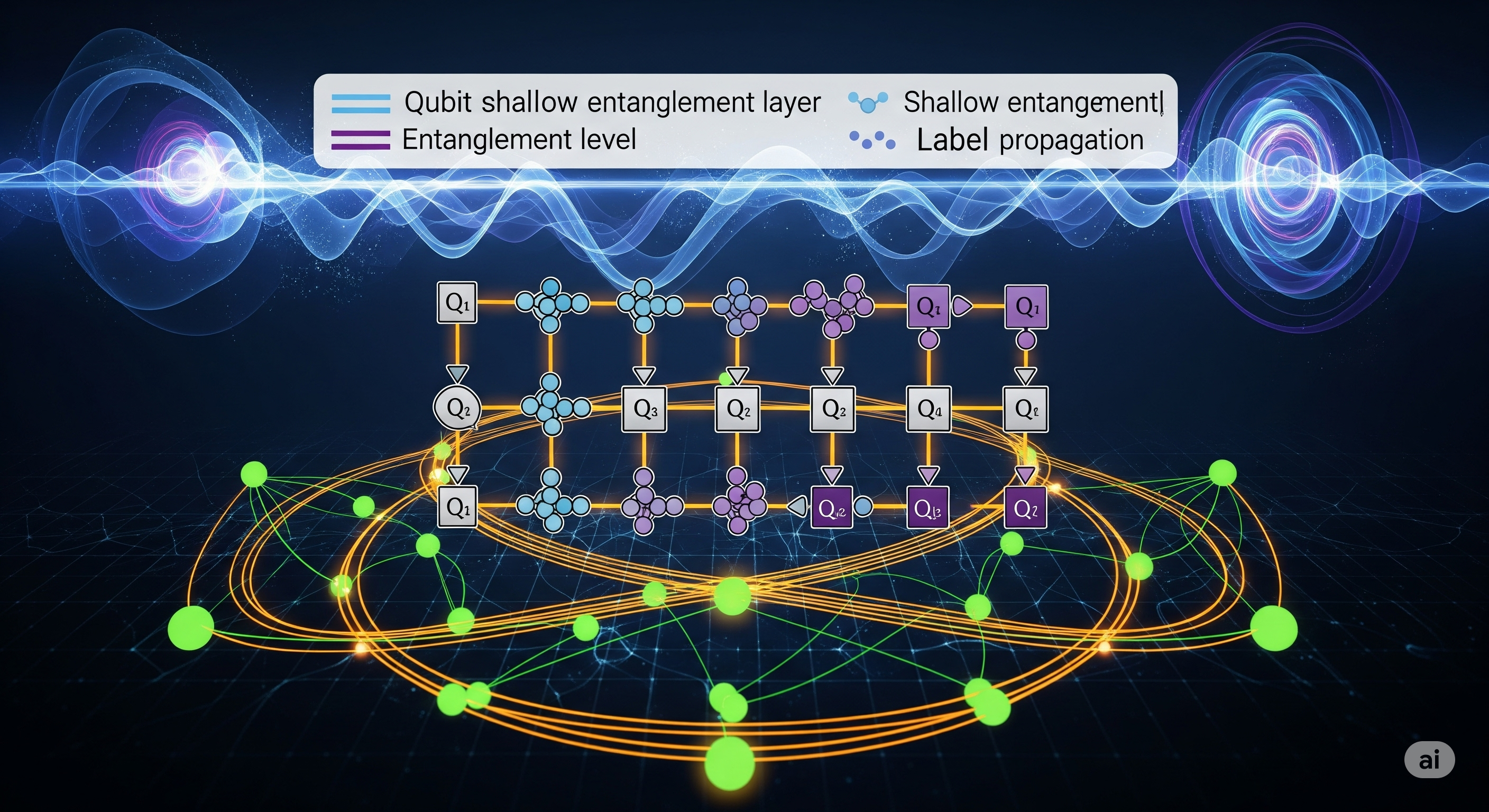
In data-scarce domains, the bottleneck isn’t computing power — it’s labeled data. Semi-supervised learning (SSL) thrives here, using a small set of labeled points to guide a vast sea of unlabeled ones. But what happens when we bring quantum mechanics into the loop? This is exactly where Improved Laplacian Quantum Semi-Supervised Learning (ILQSSL) and Improved Poisson Quantum Semi-Supervised Learning (IPQSSL) enter the stage. From Graphs to Quantum States Both ILQSSL and IPQSSL operate in the graph-based SSL paradigm, where data points become nodes and similarity measures define edges. The twist is how they embed this graph structure directly into quantum states using QR decomposition. By decomposing graph-derived matrices into orthogonal (unitary-compatible) components, they map structure into quantum circuits without violating the unitarity constraints of quantum computing. ...

August 9, 2025 · 3 min · Zelina