
A Sunset Clause Is Not a Safety Test: Designing an Exit From Frontier AI Limits
A frontier-AI treaty needs more than an expiry date: its exit rules must balance genuine risk reduction against verification, sovereignty, and geopolitical change.
A frontier-AI treaty needs more than an expiry date: its exit rules must balance genuine risk reduction against verification, sovereignty, and geopolitical change.

A controlled comparison shows that post-training changes where confidence is useful across routing, early stopping, and completed-answer selection.

RLVP shows that scientific-code post-training improves when executable programs are graded by numerical and physical accuracy rather than rewarded for validity alone.

A financial-audit assistance system shows strong potential for ranking suspicious statements, but much weaker evidence that it can reliably explain what auditors should investigate.

BusinessCaseBench shows that frontier models already cover most expected elements of business-case analysis, while still missing the completeness needed for review-free decision support.

A controlled heart-sound experiment shows that spectrogram design matters most when model capacity is scarce, with richer front-ends preserving accuracy and reducing false alarms.

Annual satellite embeddings can improve forest-biomass monitoring not by out-sensing LiDAR, but by keeping far more field observations usable across time and geography.
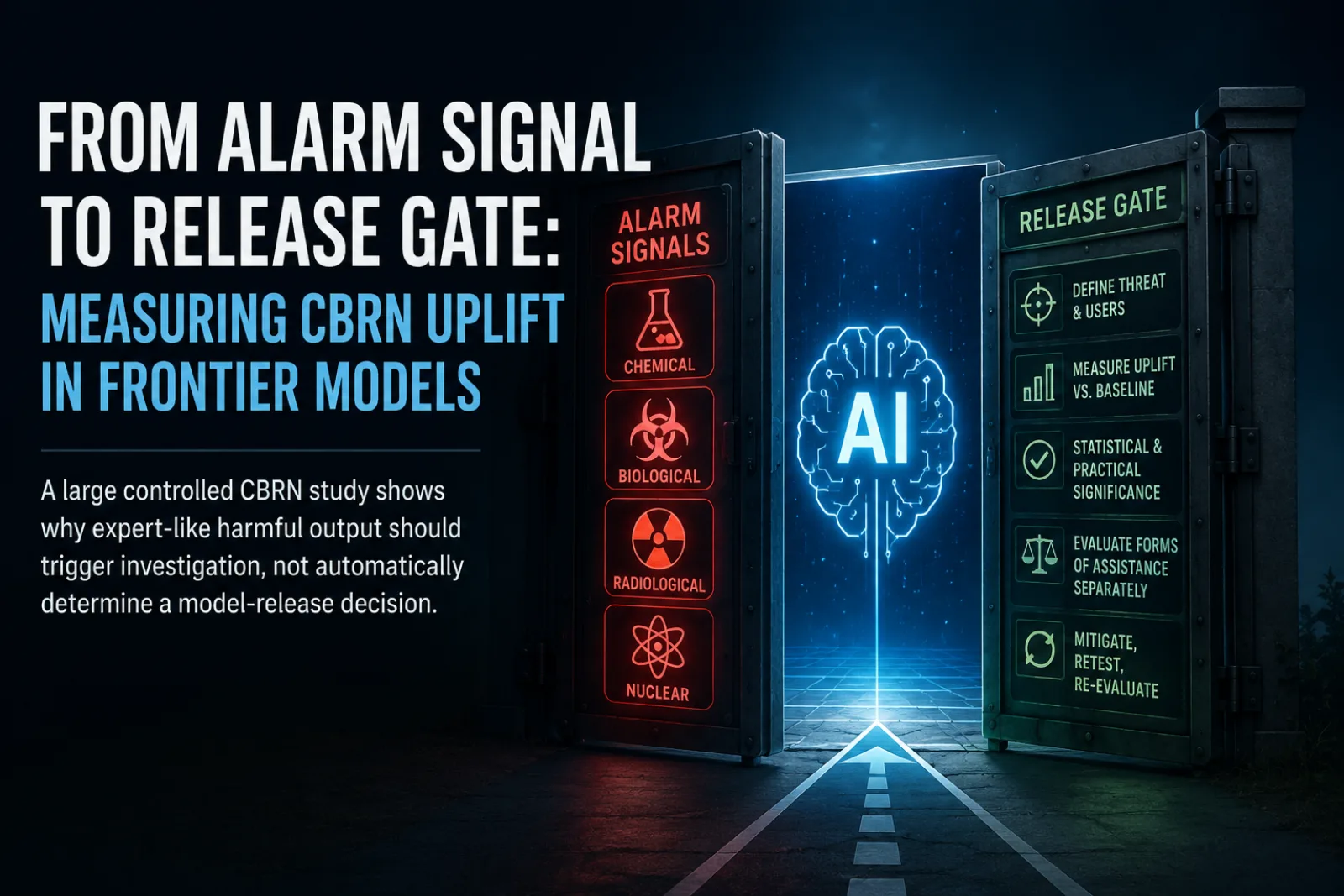
A large controlled CBRN study shows why expert-like harmful output should trigger investigation, not automatically determine a model-release decision.

Visual behavior can improve detection of conversational breakdowns, but the gains depend sharply on the interaction environment, task, and signals already available.

Two very different AI studies point to the same operational principle: intervention should scale with utility, risk, and evidence rather than defaulting to binary control.