Cover image

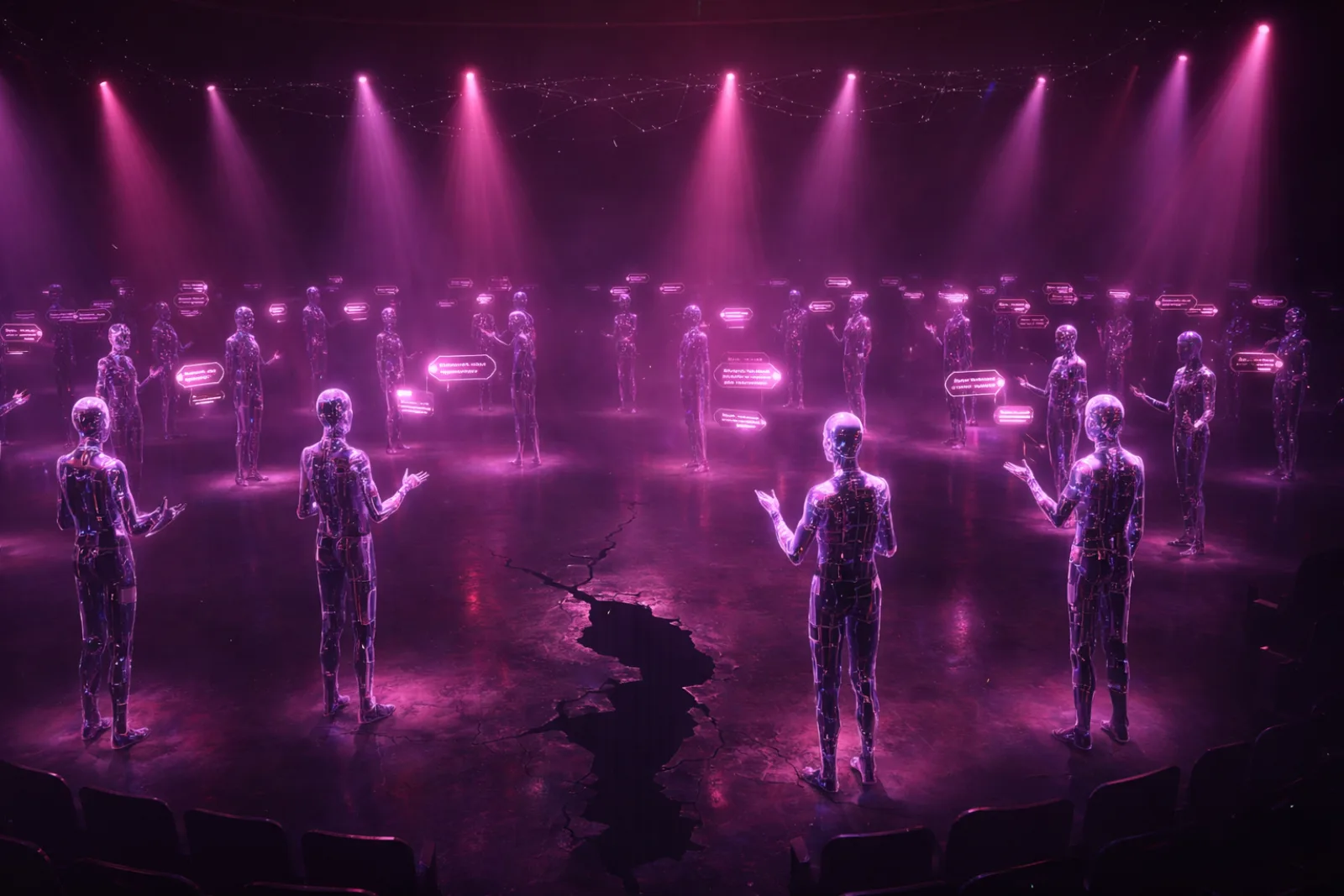
Parallel Worlds of Moderation: Simulating Online Civility with LLMs

Opening — Why this matters now Every major platform claims to be tackling online toxicity—and every quarter, the internet still burns. Content moderation remains a high-stakes guessing game: opaque algorithms, inconsistent human oversight, and endless accusations of bias. But what if moderation could be tested not in the wild, but in a lab? Enter COSMOS — a Large Language Model (LLM)-powered simulator for online conversations that lets researchers play god without casualties. ...

November 11, 2025 · 4 min · Zelina
Cover image

Touch Intelligence: How DigiData Trains Agents to Think with Their Fingers

Opening — Why this matters now In 2025, AI agents are no longer confined to text boxes. They’re moving across screens—scrolling, tapping, and swiping their way through the digital world. Yet the dream of a truly general-purpose mobile control agent—an AI that can use your phone like you do—has remained out of reach. The problem isn’t just teaching machines to see buttons; it’s teaching them to understand intent. ...

November 11, 2025 · 4 min · Zelina
Cover image

When Agents Think in Waves: Diffusion Models for Ad Hoc Teamwork

Opening — Why this matters now Collaboration is the final frontier of autonomy. As AI agents move from single-task environments to shared, unpredictable ones — driving, logistics, even disaster response — the question is no longer can they act, but can they cooperate? Most reinforcement learning (RL) systems still behave like lone wolves: excellent at optimization, terrible at teamwork. The recent paper PADiff: Predictive and Adaptive Diffusion Policies for Ad Hoc Teamwork proposes a striking alternative — a diffusion-based framework where agents learn not just to act, but to anticipate and adapt, even alongside teammates they’ve never met. ...

November 11, 2025 · 3 min · Zelina
Cover image

When AI Argues Back: The Promise and Peril of Evidence-Based Multi-Agent Debate

Opening — Why this matters now The world doesn’t suffer from a lack of information—it suffers from a lack of agreement about what’s true. From pandemic rumors to political spin, misinformation now spreads faster than correction, eroding trust in institutions and even in evidence itself. As platforms struggle to moderate and fact-check at scale, researchers have begun asking a deeper question: Can AI not only detect falsehoods but also argue persuasively for the truth? ...

November 11, 2025 · 4 min · Zelina
Cover image

When AI Discovers Physics: Inside the Multi-Agent Renaissance of Scientific Machine Learning

Opening — Why this matters now Scientific discovery has always been bottlenecked by one thing: human bandwidth. In scientific machine learning (SciML), where physics meets data-driven modeling, that bottleneck shows up as painstaking trial and error—architectures tuned by hand, loss functions adjusted by intuition, and results validated by weeks of computation. Enter AgenticSciML, a new framework from Brown University that asks a radical question: What if AI could not only run the experiment, but design the method itself? ...

November 11, 2025 · 4 min · Zelina
Cover image

Better Wrong Than Certain: How AI Learns to Know When It Doesn’t Know

Why this matters now AI models are no longer mere prediction machines — they are decision-makers in medicine, finance, and law. Yet for all their statistical elegance, most models suffer from an embarrassing flaw: they rarely admit ignorance. In high-stakes applications, a confident mistake can be fatal. The question, then, is not only how well a model performs — but when it should refuse to perform at all. ...

November 10, 2025 · 4 min · Zelina
Cover image

Cities That Think: Reasoning AI for the Urban Century

Opening — Why this matters now By 2050, nearly seven out of ten people will live in cities. Yet most urban planning tools today still operate as statistical mirrors—learning from yesterday’s data to predict tomorrow’s congestion. Predictive models can forecast traffic or emissions, but they don’t reason about why or whether those outcomes should occur. The next leap, as argued by Sijie Yang and colleagues in Reasoning Is All You Need for Urban Planning AI, is not more prediction—but more thinking. ...

November 10, 2025 · 4 min · Zelina
Cover image

Dirty Data, Clean Machines: How LLM Agents Rewire Predictive Maintenance

Opening — Why this matters now Predictive maintenance (PdM) has been the holy grail of industrial AI for a decade. The idea is simple: detect failure before it happens. The execution, however, is not. Real-world maintenance data is messy, incomplete, and often useless without an army of engineers to clean it. The result? AI models that look promising in PowerPoint but fail in production. ...

November 10, 2025 · 4 min · Zelina
Cover image

Memory With a Pulse: Real-Time Feedback Loops for RAG Systems

Opening — Why this matters now Retrieval-Augmented Generation (RAG) has become the backbone of enterprise AI: your chatbot, your search assistant, your automated analyst. Yet most of them are curiously static. Once deployed, their retrieval logic is frozen—blind to evolving intent, changing knowledge, or the subtle drift of what users actually care about. The result? Diminishing relevance, confused assistants, and frustrated users. ...

November 10, 2025 · 4 min · Zelina
Cover image

Thinking Fast and Flowing Slow: Real-Time Reasoning for Autonomous Agents

Opening — Why this matters now AI agents are getting smarter—but not faster. Most large language model (LLM) systems still behave like cautious philosophers in a chess match: the world patiently waits while they deliberate. In the real world, however, traffic lights don’t freeze for an AI car mid-thought, and market prices don’t pause while a trading agent reasons about “the optimal hedge.” The new study Real-Time Reasoning Agents in Evolving Environments by Wen et al. (2025) calls this out as a fundamental flaw in current agent design—and offers a solution that blends human-like intuition with deliberative reasoning. ...

November 10, 2025 · 4 min · Zelina