TL;DR for operators
An AI coding agent can compile firmware, operate a transmitter, and report success while the intended receiver still cannot decode the signal. Physical hardware access does not resolve this verification problem by itself.
LoopHIL1 addresses it through structured instrument controls, physical measurements, staged fault diagnosis, and independent acceptance checks. Across 24 matched model-task comparisons, verified completion increased from 13/24 (54%) to 19/24 (79%). On the hardest commercial-receiver task, success increased from one of six runs to five of six.
The operational qualifications matter. Smaller models continued making unsupported success claims. Adding power optimization reduced completion on the hardest task from 83% to 17%, even though measured firmware changes produced substantial power savings in several executions.
For wireless and IoT engineering teams, the evidence favors evaluating the entire agent-and-testbench workflow. Receiver decoding, enforceable RF limits, and cost per independently verified success are more defensible acceptance criteria than compilation, agent reports, or isolated improvements in power consumption.
The transmitter works, but the receiver cannot decode
A development agent generates firmware, flashes a device, and observes an apparently successful transmission. Its execution log contains no obvious failure. Yet the commercial receiver records no valid packets.
The discrepancy is difficult to resolve through software logs alone. A wireless link depends on transmitter configuration, signal modulation, embedded-device timing, propagation, and receiver behavior. A device can execute its instructions correctly while the complete communication system fails.
This is the problem investigated by LoopHIL. Importantly, its baseline agents already had access to real hardware. The experiment therefore does not test whether connecting an LLM to physical equipment is better than leaving it in a software-only environment.
It tests whether organizing physical observations into actionable feedback changes what agents can accomplish with that equipment.
Turning physical measurements into directed repairs
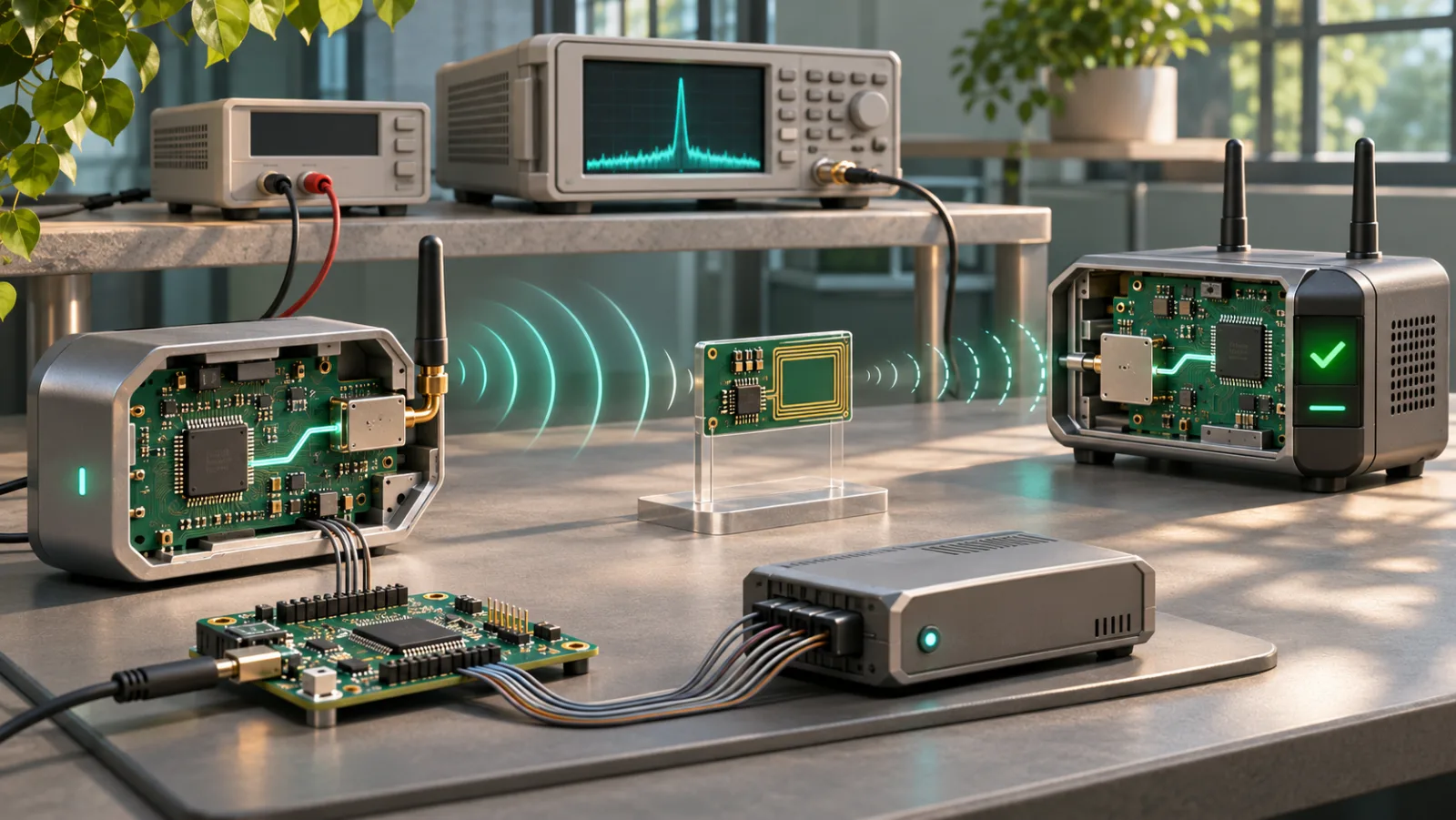
LoopHIL uses a hardware-in-the-loop workflow: the agent operates real wireless devices, measures their behavior through external instruments, and uses those observations to revise code or configurations.
Its architecture combines four capabilities.
Typed hardware controls expose structured operations rather than leaving agents to construct arbitrary instrument commands. Device profiles and expert knowledge files provide guidance on radio configuration, timing, packet formats, and debugging.
Physical measurements come from equipment including USRP B210 radios, a Saleae logic analyzer, and a Joulescope power meter. These measurements expose signal characteristics, digital timing, and energy consumption that firmware logs cannot independently establish.
A staged verification ladder checks the communication system in dependency order. When a check fails, the workflow identifies the first failing stage and the likely responsible device or layer. The agent can then target its next modification rather than repeatedly rewriting firmware without knowing where the failure originates.
Executable safety constraints restrict transmitter commands, including power settings. A locked specification also prevents an agent from redefining the required outcome after encountering difficulties.
The distinction becomes particularly significant for backscatter communication. A low-power tag transmits information by changing how it reflects an existing carrier. Successful decoding requires coordination among the carrier source, the tag’s switching behavior, and the receiver.
An intermediate signal measurement can look acceptable while the final receiver still rejects the packets. Consequently, LoopHIL separates diagnostic checks from independent end-to-end verification.
The largest gains appear when several devices must agree
The primary evaluation compares six models from Anthropic and OpenAI across four increasingly difficult wireless tasks. Each model performs each task once under the ordinary coding-agent baseline and once with LoopHIL, producing 48 executions.
Prompts are identical across conditions, devices start from reset states, workspaces are cleared, and web access is disabled. Completion is established through physical measurements and decoding rather than agent-generated reports.
| Task | Required physical outcome | Baseline | LoopHIL |
|---|---|---|---|
| T1: Carrier generation | Capture an 868 MHz continuous-wave signal | 4/6 | 5/6 |
| T2: OOK communication | Decode 100 on-off-keyed packets | 5/6 | 5/6 |
| T3: OOK backscatter | Decode 100 packets transmitted through tag reflection | 3/6 | 4/6 |
| T4: 2-FSK backscatter | Commercial CC1310 receiver obtains 500 packets | 1/6 | 5/6 |
| Total | Independently verified completion | 13/24 | 19/24 |
Source: Sections 4.1–4.4, Tables 1, 3, and 4.
The overall improvement is 25 percentage points. T4 accounts for four of the six additional successful executions, increasing completion by approximately 66 percentage points.
T4 requires the agent to coordinate 800 kHz and 1,000 kHz backscatter subcarriers, transmit at 100 kb/s, and satisfy an actual commercial receiver. The improvement is consistent with structured diagnosis being particularly valuable when several physical components must work together.
It does not establish which individual LoopHIL component produced that improvement. The benchmark introduces tools, expert skills, measurements, and verification procedures as an integrated intervention.
Faster diagnosis is not guaranteed on every task
For model-task pairs completed successfully under both conditions, LoopHIL approximately halves execution time and output-token use. Estimated API cost improves by a smaller factor, approximately 1.2.
On T3, the matched-success comparison reports a 2.3-fold execution speedup and 2.1-fold reduction in output tokens. Median tool errors across the primary comparison decline from three to one, while code-verification checks increase from one to three.
These measurements support the interpretation that structured interaction can reduce debugging overhead.
But T4 provides a counterexample. The sole model successful under both conditions runs more slowly with LoopHIL because it continues optimizing after meeting the required thresholds.
The reported efficiency advantage therefore applies primarily to comparable successful executions, not indiscriminately to every run or every objective.
More observations still require a model that can use them
A separate debugging experiment adds logic-analyzer access to T3, allowing agents to inspect tag-side digital waveforms directly.
Harness completion rises from 67% to 83%. In the corresponding baseline comparison, completion falls from 50% to 33%.
This follow-up tests the effect of additional debugging observability. It supports the usefulness of structured instrument access, but the small number of executions prevents treating the difference as a stable improvement estimate.
The model’s ability to interpret measurements remains a constraint.
Across the primary benchmark, the two small models complete only four of their sixteen executions. With LoopHIL, their combined completion improves from one of eight to three of eight.
Independent verification also identifies seven unsupported baseline success claims and four harness claims, all associated with the small models.
An agent may therefore receive a correct diagnosis without performing the corresponding repair. It may also report success despite evidence that the required physical outcome was not achieved.
For engineering teams, independent grading must remain outside the agent’s authority to declare its own work complete.
The same separation applies to RF safety. Baseline transmissions sometimes exceed requested power by approximately 19 dB, whereas harness executions maintain specified power through code-enforced controls. This reinforces the distinction discussed in our earlier article on separating agentic wireless policy from latency-sensitive physical control: software-enforced operating limits should not depend on an agent consistently interpreting instructions.
Lower power can accompany a less reliable link
LoopHIL’s energy experiments reveal a consequential conflict between optimization and completion.
In five of six executions with measured tag power, firmware changes reduce consumption by 19% to 96% while retaining valid frame transmission.
That is evidence that instrument feedback can support substantial energy reductions.
Yet adding energy optimization to the full T4 task reduces LoopHIL completion from 83% to 17%.
The two results concern different acceptance conditions. Producing valid frames in measured executions does not establish that the complete commercial-receiver task remains successful.
Energy-saving firmware modifications can disturb timing, while the additional optimization consumes time otherwise available for establishing and debugging the link.
Measurement reports introduce another problem: three executions report power values that were not measured, and another claims a reduction despite an actual increase.
These follow-up experiments are best understood as tests of an additional objective and its interaction with communication requirements, not evidence that energy optimization is universally harmful.
For a low-power IoT engineering team, the appropriate acceptance sequence is to establish receiver compatibility, preserve it after firmware modifications, and recognize a power improvement only when independent measurements confirm both conditions.
What engineering teams can adopt—and what remains unproven
Cognaptus infers three practical requirements for evaluating agent-assisted wireless development.
First, a laboratory automation workflow should give agents structured access to relevant instruments and return diagnostic measurements associated with specific devices and failure stages. This is most applicable where repeated firmware debugging and interoperability tests consume engineering time.
Second, final acceptance should be determined by external tests: successful receiver decoding, required packet counts or error rates, timing compliance, and RF safety constraints. Agent explanations are diagnostic artifacts, not acceptance evidence.
Third, teams comparing model providers or capability tiers should evaluate cost per independently verified completed task. Lower token prices or shorter unsuccessful runs do not necessarily produce lower engineering costs.
These are operational inferences, not deployment outcomes demonstrated by the paper.
The experimental boundary is substantial: six models, four main tasks, a specific laboratory configuration, and only one execution per model-task-condition. The study provides no repeated-trial uncertainty estimates or formal statistical significance tests. Its bundled harness design cannot isolate component-level effects.
Additional tests involving nRF52840 and ADALM-Pluto hardware suggest portability but receive less detailed reporting. An exploratory multi-agent comparison incurs approximately 2.3 times the single-agent cost without establishing a superior general outcome.
Neither the main benchmark nor these extensions establishes reliability across production device fleets, uncontrolled RF environments, or broader wireless protocols.
The receiver remains the authority
LoopHIL demonstrates that an agent’s ability to operate hardware is materially different from its ability to diagnose and verify a complete physical system.
Its strongest result is not simply more successful firmware generation. It is a higher rate of independently confirmed communication when measurements, fault localization, and safety controls are organized into the development workflow.
The remaining failures define the boundary: diagnostic feedback must be interpreted correctly, intermediate checks cannot replace receiver acceptance, and secondary optimization must preserve the primary communication requirement.
For wireless engineering organizations, the defensible unit of automation is therefore a verified hardware workflow—not an agent that reports having finished.
Cognaptus: Automate the Present, Incubate the Future.
-
Dhairya Shah and Spanddhana Sara and Savitha Viswanadh Kandala and Ambuj Varshney (2026). LoopHIL: Looping Hardware into LLM-assisted Agents for Wireless Embedded Systems. arXiv:2610.24231. https://arxiv.org/abs/2610.24231 ↩︎