TL;DR for operators
Improving an interactive visual agent requires feedback from actions, and collecting that feedback can be expensive. In Vision-Language Agents Can Learn in Their Own Latent Worlds, Li and colleagues introduce Dwell, which lets an agent practice on predicted internal states rather than generating images of possible futures.1
Across five simulated environments, Dwell achieves 0.38 aggregate task success, compared with 0.28 for GRPO, 0.24 for adapted LeWorldModel, and 0.18 for PPO. The advantage is conditional: GRPO substantially outperforms Dwell on Navigation, and a simpler latent-model baseline requires less computation.
Dwell’s strongest contribution is architectural. Prediction and decision-making use compatible representations, enabling imagined experience to train the policy directly. Ablations support this design, but the method still depends on real interactions to correct its predictions.
Operational implication: Teams developing interactive visual agents can investigate latent imagination as a way to reuse collected experience. Adoption should depend on task-specific success, real-interaction efficiency, total GPU-hours, and predictive reliability—not aggregate benchmark ranking alone.
The Agent Can Practice Without Generating the Next Image
Consider a visual agent learning to perform a sequence of actions. Each real attempt produces observations and feedback, but executing another attempt may consume simulator time, compute, or operational resources.
A learned model of the environment could provide additional training experience. The conventional difficulty is deciding what that model must generate. Reconstructing an entire future visual observation may be unnecessary if the policy only needs information sufficient to choose its next action.
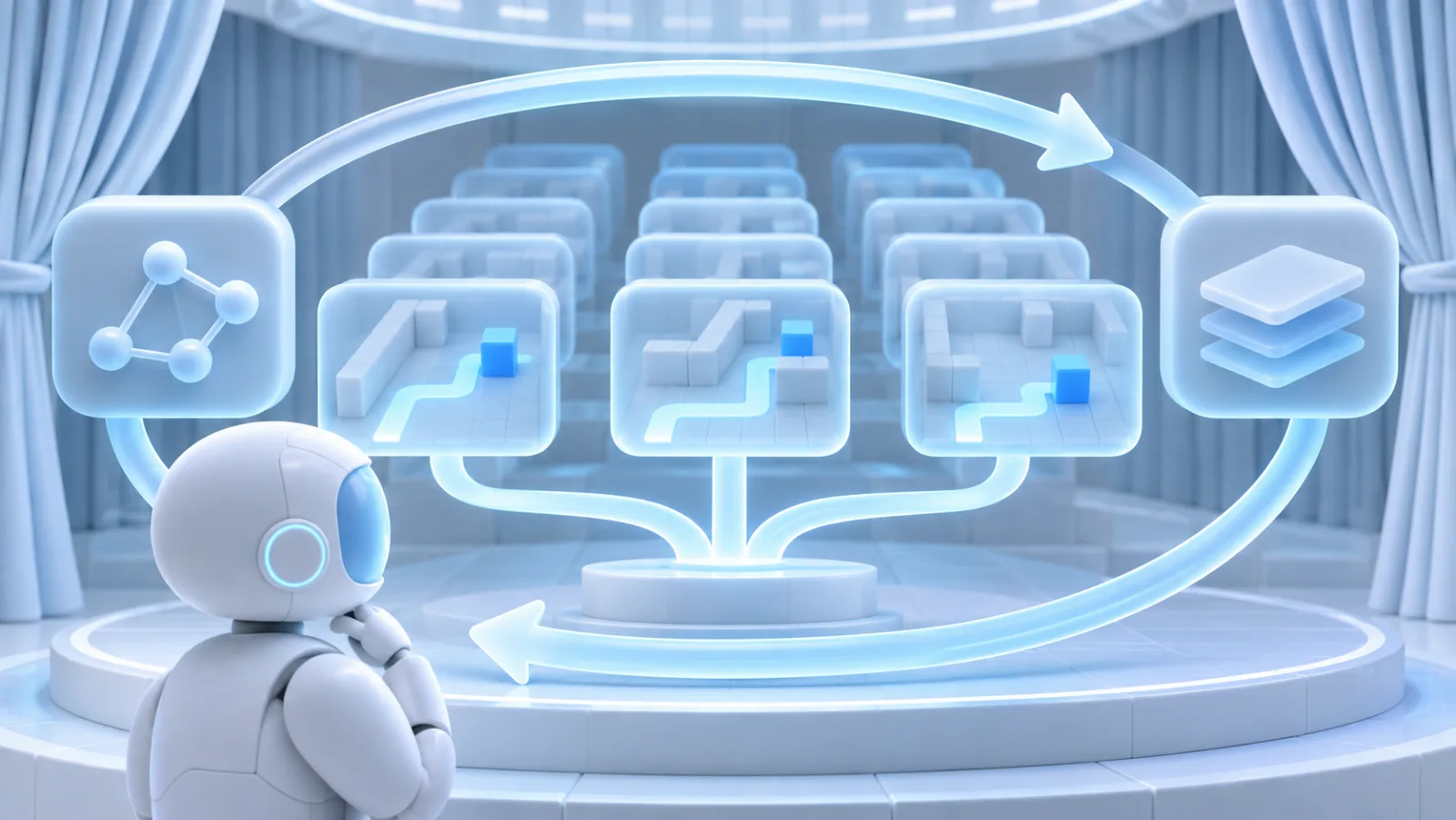
Dwell investigates that possibility through latent states: compact internal representations of an agent’s understanding of its environment.
Instead of generating a picture after each hypothetical action, the agent predicts how its latent state would change. It then estimates the reward associated with that predicted state and uses the resulting imagined trajectories to improve its policy.
The distinction matters because an internal prediction can be cheaper than visual reconstruction while still containing information relevant to action selection. Whether it actually retains that information is the central empirical question.
The Aggregate Gain Conceals Substantial Task Differences
The paper’s main benchmark compares trainable methods initialized from Qwen2.5-VL-3B, using matched interaction budgets, environment interfaces, and evaluation protocols.
The reported success rates reveal both the potential and limits of latent imagination.
| Environment | Dwell | GRPO | LeWorldModel | PPO |
|---|---|---|---|---|
| Sokoban | 0.53 | 0.21 | 0.44 | 0.29 |
| FrozenLake | 0.51 | 0.19 | 0.29 | 0.22 |
| Navigation | 0.39 | 0.73 | 0.29 | 0.28 |
| PrimitiveSkill | 0.28 | 0.17 | 0.04 | 0.07 |
| EB-ALFRED | 0.18 | 0.10 | 0.13 | 0.06 |
| Overall | 0.38 | 0.28 | 0.24 | 0.18 |
Source: Section 3.2, Table 1. Values are reported success rates; the overall row reproduces the paper’s aggregate.
Dwell’s overall advantage over GRPO is 10 percentage points. On Sokoban and FrozenLake, the advantage reaches 32 percentage points in each environment. These results suggest that predicting future states can provide valuable training information for tasks involving spatial consequences and sequential decisions.
Navigation reverses the comparison. GRPO reaches 0.73 success while Dwell reaches 0.39, a 34-percentage-point disadvantage for Dwell. The additional predictive machinery does not consistently translate into better choices.
One reporting inconsistency also deserves attention. The paper’s surrounding narrative characterizes GRPO as slightly stronger on PrimitiveSkill, whereas Table 1 reports 0.28 for Dwell and 0.17 for GRPO. The displayed numerical comparison favors Dwell; that discrepancy should not be silently reconciled.
The evaluation covers 588 episodes per evaluation configuration across five heterogeneous simulated environments, with trainable methods generally reported across three training seeds. These controlled comparisons establish relative performance within the protocol, not statistical certainty across broader deployments.
Larger off-the-shelf models also obtain higher reported aggregate scores, including 0.60 for Claude 4.5 Sonnet and 0.55 for GPT-4o. Those models are not trained through the same online procedure, so their results provide capability context rather than a matched learning-method comparison.
Sharing the Latent Interface Makes Predictions Directly Actionable
Dwell uses a frozen Qwen2.5-VL-3B backbone with separate trainable LoRA adapters for world modeling and policy learning.
Its learning process distinguishes two internal states:
- An observation-conditioned posterior state, updated using what the agent actually observes after acting.
- An action-conditioned prior state, predicting what should happen from the preceding state and action without seeing the next observation.
These terms describe deterministic latent representations, not calibrated Bayesian probability distributions.
The world model learns to bring its predicted prior states closer to posterior states derived from observed outcomes. A frozen V-JEPA2 visual encoder supplies additional representation targets, helping preserve perceptually meaningful information. A learned reward model evaluates predicted states.
During latent imagination, the current policy selects hypothetical actions, the world model predicts subsequent states, and the reward model estimates feedback. PPO then updates the policy and value function from those trajectories. New real interactions periodically correct the world model as the policy changes.
Crucially, the predicted states can be consumed directly by the policy. Dwell does not need to decode them into images and then encode those images again for decision-making.
The shared interface is not merely an implementation convenience. An architectural ablation in Appendix A.3, Table 2 compares it with a version that learns a bridge between separate predictive and decision representations.
| Environment | Shared interface | Bridged interface | Difference |
|---|---|---|---|
| Sokoban | 0.53 | 0.38 | +15 pp |
| FrozenLake | 0.51 | 0.42 | +9 pp |
| Navigation | 0.39 | 0.31 | +8 pp |
The shared design performs better in all three tested environments. This ablation supports the claim that representation compatibility contributes to policy performance, rather than merely establishing that latent world modeling is beneficial.
Other component ablations strengthen the mechanism. Removing action-conditioned dynamics supervision causes larger performance reductions than removing perceptual grounding in the reported Sokoban and Navigation tests, although both components contribute. Freezing the world model after initial training also causes policy improvement to saturate earlier on Sokoban and FrozenLake.
These results explain why continually correcting predictions matters when the policy begins visiting states that its earlier experience did not adequately represent.
Avoiding Image Generation Does Not Guarantee the Lowest Training Cost
Dwell’s computational comparison provides a qualified efficiency result.
Across four evaluated environments, end-to-end training GPU-hours are approximately 38–58% lower than AdaWorld, a generative world-model baseline (Section 3.3, Figure 3).
That comparison includes training expenditure, rather than measuring only the marginal cost of an imagined transition. It therefore speaks more directly to the expense of completing the learning workflow.
However, LeWorldModel remains computationally cheaper than Dwell in the reported comparison.
The architectural choice consequently involves at least three quantities: the amount of real interaction required, achieved task success, and total training computation. A more capable imagined-state learner may justify its additional computational cost for one task while providing insufficient improvement for another.
For organizations training visual agents under constrained resources, the relevant measurement is the performance-cost frontier under a fixed task definition and evaluation budget. Lower-cost imagination is valuable only when its predictions generate sufficient improvements in actual evaluated behavior.
Predicted Experience Still Requires Verification
Dwell’s main reliability boundary comes from the world model itself.
Its deterministic transitions do not explicitly quantify predictive uncertainty. Errors in successive state predictions and learned rewards can accumulate during longer imagined trajectories. A policy trained on those trajectories may therefore optimize behavior against inaccurate representations of what its actions would accomplish.
A separate issue is representational sufficiency. Compact states can omit fine-grained information needed for some contact-rich manipulation tasks. The weaker Navigation result also demonstrates that predictive training offers no guaranteed advantage when the task’s immediate observations already support effective action selection.
The experiments do not establish reliable long-horizon planning under distribution shift, safe physical-world interaction, or persistent lifelong adaptation. They evaluate five simulated environments with one trainable VLM backbone.
For consequential agent workflows, these are deployment boundaries rather than evidence that latent imagination cannot work. They identify additional measurements required before hypothetical experience can be treated as dependable guidance.
What an Agent Team Should Test Before Adopting Dwell
Cognaptus interpretation: Dwell is most relevant when a team is developing an interactive visual agent, real environment attempts are costly, and collected trajectories contain information that can support prediction of future action consequences.
The architecture warrants a controlled comparison against a simpler model-free learner and a cheaper latent-world alternative.
Such an evaluation should examine:
- Task-level success and interaction efficiency. Does the added imagined experience improve held-out success with the same real-interaction budget?
- Total training cost. Are additional world-model and reward-model updates justified by the improvement, measured in end-to-end GPU-hours?
- Prediction quality over rollout length. How quickly do latent-state and reward predictions diverge from observed outcomes?
- Value of continued correction. Does refreshing the world model with newly collected interactions improve performance relative to freezing it?
- Representation compatibility. Does sharing the predictive and decision interface outperform a separate representation bridge for the target task?
For teams considering more consequential automation, predicted rewards should remain distinguishable from verified environmental outcomes. Unvalidated imagined trajectories should not independently justify irreversible decisions.
This question connects to our earlier examination of World Action Planner, which addresses planning through modeled action consequences. Dwell investigates a different architectural choice: whether compact predictive representations can directly become policy-training experience. Both motivate task-specific validation rather than assuming simulated improvement guarantees deployment reliability.
The Contribution Is Reusable Experience, Not a Verified Future
Dwell demonstrates that a pretrained vision-language model can support both prediction and action learning through shared latent representations. Its aggregate benchmark advantage, targeted ablations, and lower training cost relative to a generative baseline provide substantive evidence for the approach.
The results also establish why the choice remains conditional. Some tasks benefit more than others, simpler latent methods can cost less, and imagined states are not guaranteed to represent future environmental outcomes accurately.
For agent developers, the promising direction is to extract more policy-training value from each real interaction without reconstructing every hypothetical future observation. The next requirement is to measure when those internal predictions remain informative enough to improve actual decisions.
Cognaptus: Automate the Present, Incubate the Future.
-
Haoxi Li and Sikai Bai and Jianfei Ma and Qinglin Hou and Xiaocheng Lu and Tao Han and Jie Zhang and Song Guo (2026). Vision-Language Agents Can Learn in Their Own Latent Worlds. arXiv:2610.36925. https://arxiv.org/abs/2610.36925 ↩︎