TL;DR for operators
A multi-camera recommendation system has to answer two different questions at the same decision point: what has just happened in the recent sequence, and which available camera should come next. Putting both into one attention stream is a reasonable default, but the paper suggests that keeping recent-shot history separate from the candidate views can improve the recommendation itself.
A Dual-Transformer for Multi-Camera View Recommendation1 makes that separation explicit. Recent shots are encoded as one source of context, candidate cameras are encoded separately, and each candidate can retrieve the parts of the same history that matter to its evaluation. Under the cleanest matched comparison—SwinV1 features and binary cross-entropy—the Dual-Transformer reaches 52.60% [email protected] versus 47.97% for the authors’ single-Transformer reimplementation. Here, [email protected] evaluates recommendations produced after applying a score threshold; it is distinct from asking whether the model’s single highest-scoring camera is correct.
The larger 69.65% result should be interpreted differently. It combines the Dual-Transformer with Focal Loss and a SwinV2-Tiny visual backbone, so it represents a stronger overall configuration rather than the isolated effect of architectural separation.
For a production workflow, the more interesting extension may be adaptation. Using 20% of local training data raises same-video [email protected] from 74.44% to 83.65% on one studied video and from 81.76% to 84.12% on the other. That suggests a route from a generic recommender toward show-specific behavior, but the evidence comes from only two target videos and contains no reported run-to-run uncertainty.
Camera selection is really two prediction problems
At an editing boundary, the system is not simply choosing one image from six alternatives. It first needs a usable account of the preceding sequence: which cameras were recently shown, how the shot pattern has evolved, and what visual events have just occurred. It must then judge several synchronized candidate views against that history.
Those information types play different roles. The past is a sequence to be summarized. The candidates are alternatives to be compared.
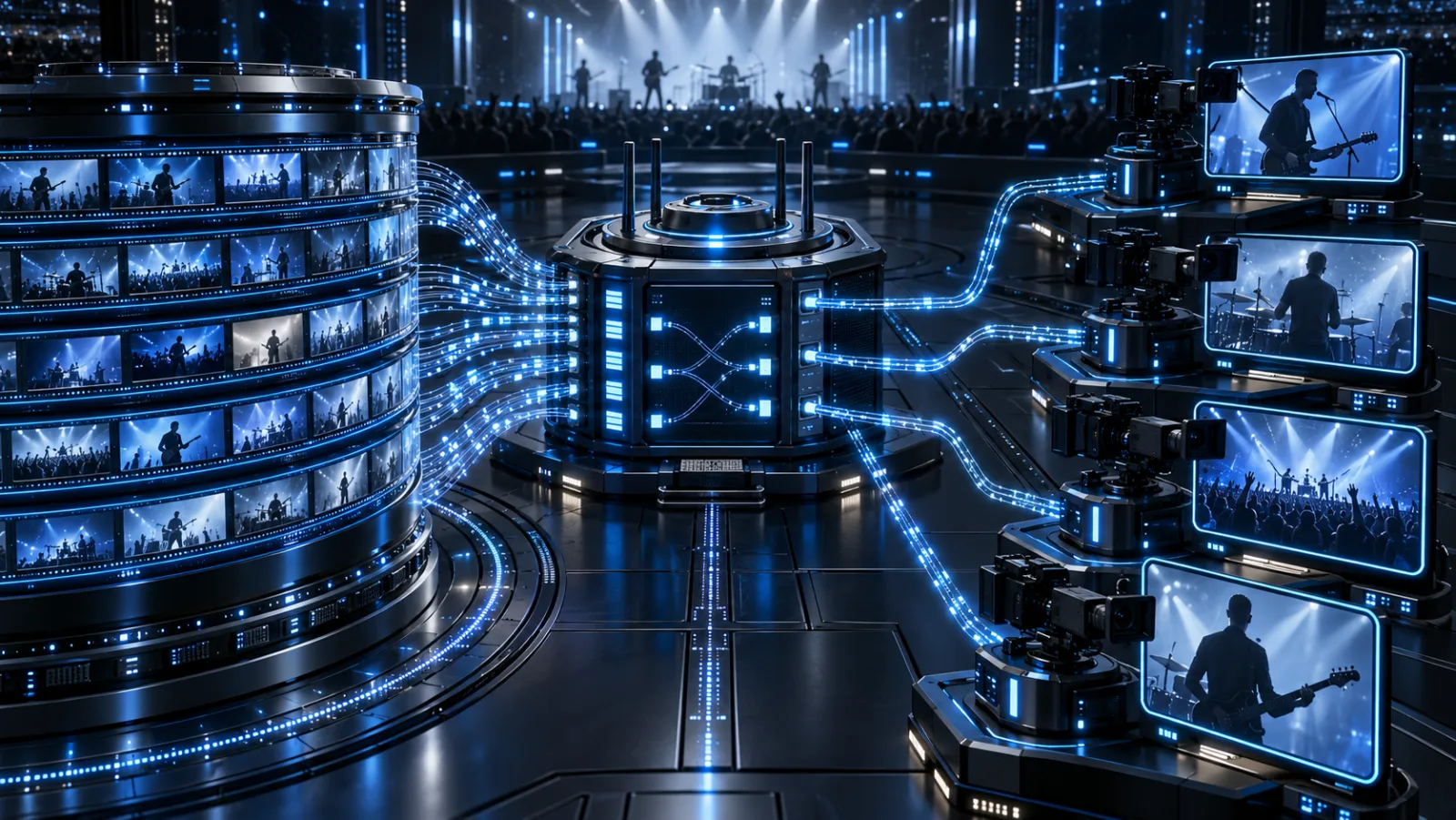
The paper’s architectural change follows directly from that distinction. Sixteen past shots are processed by a one-layer Temporal Transformer into a historical memory. Six candidate views pass through a separate Candidate Transformer. The candidates then query the historical memory through multi-head cross-attention before another attention layer models interactions among the candidate views themselves.
In plain terms, each candidate is allowed to ask a different question of the same recent history. A close-up may need different historical evidence than a wide shot. The model does not have to fuse the entire past and every future option into one sequence before it knows which information is relevant to which choice.
Separation improves the matched architecture comparison
The most informative architecture test is not the paper’s highest number.
With the same SwinV1 backbone and the same BCE loss, the authors’ single-Transformer reimplementation reaches 47.97% [email protected]. Replacing it with the Dual-Transformer raises the metric to 52.60%.
That 4.63-percentage-point difference is the cleaner evidence for the architectural claim because the visual encoder and loss function remain fixed. It indicates that reorganizing the interaction between history and candidate views changes recommendation quality even without upgrading the image backbone.
This comparison also has a practical implication for model-development sequencing. If a team faces mediocre recommendation quality, increasing encoder capacity is not the only available lever. The way historical context is exposed to candidate decisions may itself be a bottleneck.
The result remains benchmark evidence rather than a causal decomposition. The prior state-of-the-art implementation was not publicly available, so the relevant single-Transformer comparison is the authors’ reimplementation rather than the original model. The paper also reports point estimates rather than repeated-run variance.
The 69.65% result belongs to the whole performance stack
Once the architecture is fixed, two other choices materially alter the outcome.
First, changing the loss matters. With the Dual-Transformer and SwinV1, replacing BCE with Focal Loss raises [email protected] from 52.60% to 56.60%. The task contains one correct view among multiple candidates, and Focal Loss reduces emphasis on easier classifications while concentrating more training weight on harder decisions.
Second, the visual backbone matters substantially. Holding the Dual-Transformer and Focal Loss constant, SwinV2-Tiny reaches 69.65%, compared with 58.63% for MaxViT-Tiny and 56.60% for SwinV1-Tiny. ViT-Base, by contrast, reaches 25.85% in the same backbone comparison.
This is why 69.65% should not be read as “the Dual-Transformer improved performance from 47.97% to 69.65%.” Between those two numbers, the loss function and visual representation also change.
For system evaluation, the paper therefore supports a component view rather than a single-model headline. Information routing, loss design, and backbone selection each affect the result, and the benchmark does not isolate them into one universal ordering beyond the tested TVMCE configurations.
Threshold choice changes what “good” recommendation means
[email protected] is also not equivalent to top-1 camera-selection accuracy.
The paper separately evaluates the operating threshold used to turn candidate scores into positive recommendations. Selecting the threshold on validation data gives $\tau=0.3$ under macro averaging, producing 74.66% test precision, 80.35% recall, and 76.52% F1. Under micro averaging, validation selects $\tau=0.4$, producing 77.52% precision, 74.75% recall, and 76.11% F1.
The model’s threshold-free Recall@1 is 76.31%: in that evaluation, the highest-confidence candidate corresponds to the ground-truth view in 76.31% of samples.
For an operational system, these measures answer different questions. A tool that exposes several suggested cameras above a confidence threshold has a different error profile from one that always returns exactly one camera. The appropriate threshold should therefore be validated against the intended interface and tolerance for extra recommendations rather than inherited mechanically from the training setup.
Limited local footage may be enough to change recommendations
The paper’s adaptation experiment moves the problem closer to production practice.
The general model begins at 74.44% [email protected] on video_0000 and 81.76% on video_0001. Fine-tuning with 20% of local target-video training data raises same-video performance to 83.65% and 84.12%, respectively. At 30%, the corresponding same-video results reach 90.41% and 86.18%.
That creates a plausible business pathway: train a broadly useful model, then adapt it using footage from a recurring program or production environment rather than rebuilding the system from scratch.
The cross-video results also show why this should not yet be described as universal editor personalization. Transfer depends on direction. With 20% fine-tuning data, training on video_0001 and testing on video_0000 reaches 83.65%, while the reverse direction reaches 76.47%.
The paper demonstrates that local adaptation can matter. It does not establish how reliably that behavior carries across many editors, genres, production crews, or camera conventions.
The deployment question is broader than model accuracy
For a media workflow, the paper directly shows improved camera-view recommendation on TVMCE and preliminary adaptation on two sequences. Cognaptus would extend that evidence into three separate engineering decisions.
The first is architectural: decide whether historical context and candidate options should share one representation path or interact through an explicit retrieval step. The second is representational: benchmark the visual backbone instead of assuming that a nominally stronger encoder will transfer cleanly to this decision task. The third is operational: choose thresholds according to how recommendations will actually be surfaced to editors.
What remains uncertain is equally specific. TVMCE is the primary benchmark; the adaptation study contains only two target videos; the model uses visual rather than multimodal evidence; and the reported results contain no confidence intervals or repeated-run variability. The system recommends which camera to choose at an editing boundary—it does not yet decide when a cut should occur or perform complete automated editing.
The broader result is therefore not that automated editing has been solved. It is that camera recommendation becomes easier to reason about when the model architecture reflects the structure of the decision itself: remember the sequence, evaluate the options, and let each option retrieve the part of history it needs.
Cognaptus: Automate the Present, Incubate the Future.
-
Josep Cabacas-Maso and Carles Ventura and Ismael Benito-Altamirano (2026). A Dual-Transformer for Multi-Camera View Recommendation. arXiv:2608.25601. https://arxiv.org/abs/2608.25601 ↩︎