TL;DR for operators
Long-context teams face a familiar choice: compute fewer token-to-token interactions, compress global interaction structure, or accept the quadratic cost of exact attention. The harder design question is what happens when two cheaper approximations are combined. If each branch normalizes its own output over a different effective support, simply adding or gating them can give the branches incompatible scales.
ELSAA addresses that specific failure mode. Heidari, Rahimi, and Moon combine an exact sparse branch with a low-rank global branch, then rescale the sparse contribution according to estimated denominator mass before token-wise gating.1 In the paper’s matched ablation, that correction lifts average test accuracy across four long-context non-causal classification tasks from 45.48% to 46.81%, with the branches, gates, architecture, hyperparameters, and optimization budget otherwise unchanged.
For operators, the paper supports a conditional architectural choice rather than a universal replacement. ELSAA is strongest on several structured long-vision tasks and remains robust across extreme Needle-in-a-Haystack sequence lengths, while the low-rank RACE branch is slightly better on some diffuse long-text tasks. Its fixed-budget attention-interaction cost is linear in sequence length, but production speed and cost gains still depend on kernel quality and scaling behavior that the paper does not test.
Two efficient branches can still be mis-scaled
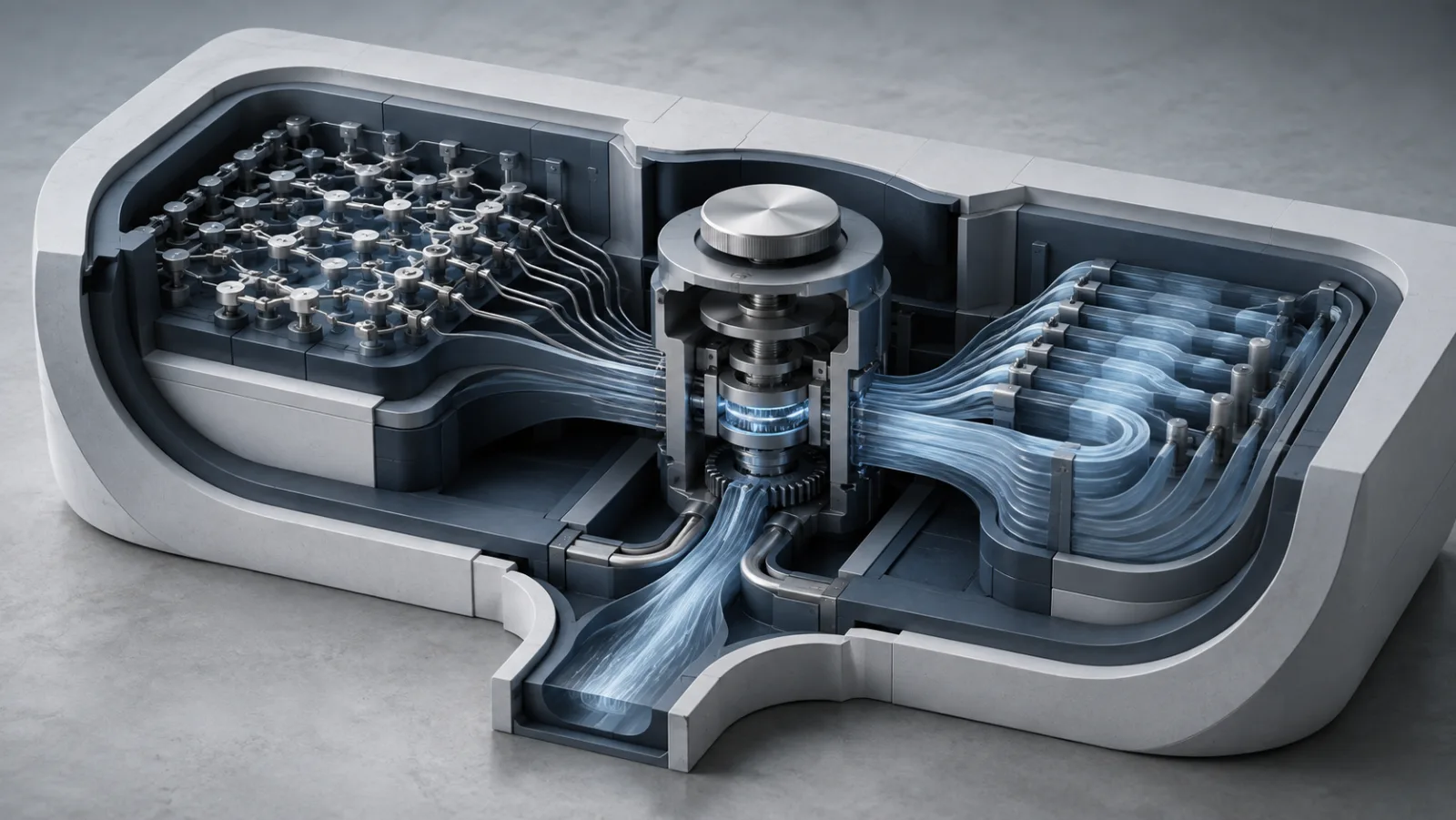
Sparse attention and low-rank attention reduce the same quadratic bottleneck in different ways. The sparse branch computes only selected query-key interactions, preserving sharp, high-similarity relationships exactly. The RACE branch compresses broader interaction structure into hash-bucket summaries, giving each query access to global context without constructing the full attention matrix.
That complementarity creates a reason to combine them. It also creates the paper’s central problem: each branch produces an attention output normalized over a different effective denominator. A sparse branch may cover only a small, high-mass subset of interactions, while the low-rank branch approximates a much broader mass. Their individually normalized outputs therefore do not necessarily represent comparable shares of the original attention operator.
ELSAA corrects that mismatch before fusion. For query token $i$, the sparse multiplier is
The final output then combines the rescaled sparse branch and the low-rank branch through independent learned gates:
This is also where a common interpretation goes wrong. ELSAA does not decompose $W_Q$, $W_K$, $W_V$, or $W_O$ into sparse and low-rank factors. Dense projections are still formed first; ELSAA approximates the input-dependent attention operator that follows them.
The ablation isolates the actual contribution
The cleanest evidence is not the best benchmark number. It is the comparison between ELSAA and Sort_Lsh_RACE, which uses the same sparse and RACE branches, the same gating architecture, and the same training setup but fixes the sparse multiplier to one.
Across ArXiv 32K classification and three 16K-token vision tasks, ELSAA averages 46.81% test accuracy versus 45.48% for the uncorrected hybrid. A 1.33 percentage-point gain is not large enough to establish universal superiority, but the comparison is unusually informative about mechanism: the difference comes from denominator-aware rescaling rather than from adding another branch or increasing the training budget.
The remaining experiments answer different questions:
| Evidence | Likely purpose | What it supports | What it does not prove |
|---|---|---|---|
| ELSAA vs. Sort_Lsh_RACE, Table 1 | Ablation | Normalization-aware fusion contributes beyond branch composition | That ELSAA is best on every task |
| 16K vision tasks, Table 1 | Main comparative evidence | Hybrid local/global structure can materially outperform RACE on structured vision workloads | That vision gains transfer to diffuse text |
| NIAH, Table 4 | Robustness and length-extrapolation test | The hybrid remains effective far beyond its 1K training length | General long-context language-model quality |
| Causal tasks, Table 5 | Extension to strict left-to-right attention | The construction remains competitive in causal attention settings | Full autoregressive LM pretraining viability |
| Complexity analysis, Section 6 | Analytical efficiency result | Interaction count scales as $\Theta(N(s+L_s2^\gamma))$ for fixed budgets | End-to-end wall-clock or dollar savings |
Workload structure matters more than a single leaderboard
The cross-task pattern is useful precisely because it is uneven. On Oxford-IIIT Pet, Flowers-102, and Food-101 at 16K tokens, ELSAA reaches 22.51%, 42.45%, and 28.33% test accuracy, compared with RACE at 16.13%, 35.49%, and 24.00%. Those results are consistent with the paper’s premise that exact sparse interactions help when important relationships are concentrated.
Long text is less favorable to the hybrid. On ArXiv classification at 32K, RACE reaches 95.05% versus 93.93% for ELSAA. On 64K binary text retrieval, RACE records 66.30%, ELSAA 65.34%, and the uncorrected hybrid 66.00%. Shorter IMDB and Fashion-MNIST tasks also show no consistent ELSAA advantage.
The replacement question for architecture teams is therefore not “Which efficient attention method wins?” It is “Does this workload contain both sharp interactions worth preserving exactly and diffuse global information worth compressing?” If the interaction pattern is mostly diffuse, the extra sparse machinery may not buy enough accuracy to justify itself.
Length extrapolation is the strongest robustness signal
The Needle-in-a-Haystack experiment trains every model at length 1,024 and evaluates from 512 to 65,536. ELSAA stays at 100% through 16,384 tokens, scores 98.8% at 32,768, and 84.2% at 65,536. RACE falls to 4.8% and 2.2% at the two longest lengths. Sparse LSH reaches 100% at long lengths but only 24.6% at 512, while exact Flash attention runs out of memory at 32K and 64K.
This is a robustness test rather than a general language-model benchmark. Its value is narrower and still operationally relevant: a hybrid that combines sparse and global structure can avoid some severe extrapolation failures seen when either approximation is used alone.
Linear interactions are not yet production economics
For fixed sparse block size $s$, RACE table count $L_s$, and hash bits $\gamma$, the paper derives
Its 32K numerical example uses roughly $1.024\times10^7$ attention or bucket interactions versus $1.024\times10^9$ dense pairwise interactions, about a 99% reduction in that interaction count.
Cognaptus inference: for teams whose training cost is dominated by long-sequence attention, this architecture could reduce memory pressure and make longer training contexts feasible without requiring the full quadratic interaction matrix. It also leaves parameter-space compression as a separate lever because the method acts in attention space rather than factoring the projection weights.
What remains uncertain: the conversion from interaction count to infrastructure ROI. The paper does not evaluate fused causal GPU kernels, scaling laws across larger models and datasets, or full autoregressive decoder pretraining. Hashing, sorting, memory movement, and kernel utilization can materially affect realized throughput.
Full rank explains structural complementarity, not output quality
The theory adds a different kind of support. Modeling the hybrid operator as $S_\Omega + BA$, the paper proves under generic sparse-value and low-rank-factor assumptions that
Here $\nu(\Omega)$ is the maximum matching size of the sparse support graph and $r$ is the low-rank budget. If the sparse support is deficient by at most $r$, a generic rank-$r$ component can fill the missing directions and make the combined operator full rank.
This formalizes structural complementarity, but it should not be stretched into a claim about prediction accuracy or unbiased normalized attention. The probabilistic guarantee further relies on an idealized independent angular-edge model and genericity assumptions. The theorem explains why sparse and low-rank components need not be redundant; the ablation is the evidence that the proposed normalization rule helps the learned system.
The decision is whether hybrid structure earns its systems cost
ELSAA makes a focused contribution to efficient-attention design: when two approximations cover different parts of attention mass, compatibility between their normalizations can matter as much as the choice of branches themselves. The controlled ablation supports that claim, while the broader results show where hybrid structure helps and where a simpler low-rank method remains competitive.
For model teams evaluating long-context architectures, the next test is workload-specific. Measure whether important interactions are concentrated, whether global context is still necessary, whether the hybrid survives target context lengths, and whether implementation-level throughput matches the interaction-count argument. Until those systems results exist at larger decoder-model scale, ELSAA is best read as a well-supported architecture mechanism with an unfinished production case.
Cognaptus: Automate the Present, Incubate the Future.
-
Mahdi Heidari and Mohammad Mahdi Rahimi and Jaekyun Moon (2026). ELSAA: Efficient Low-Rank and Sparse Attention Approximation for Training Transformers. arXiv:2607.20214. https://arxiv.org/abs/2607.20214 ↩︎