TL;DR for operators
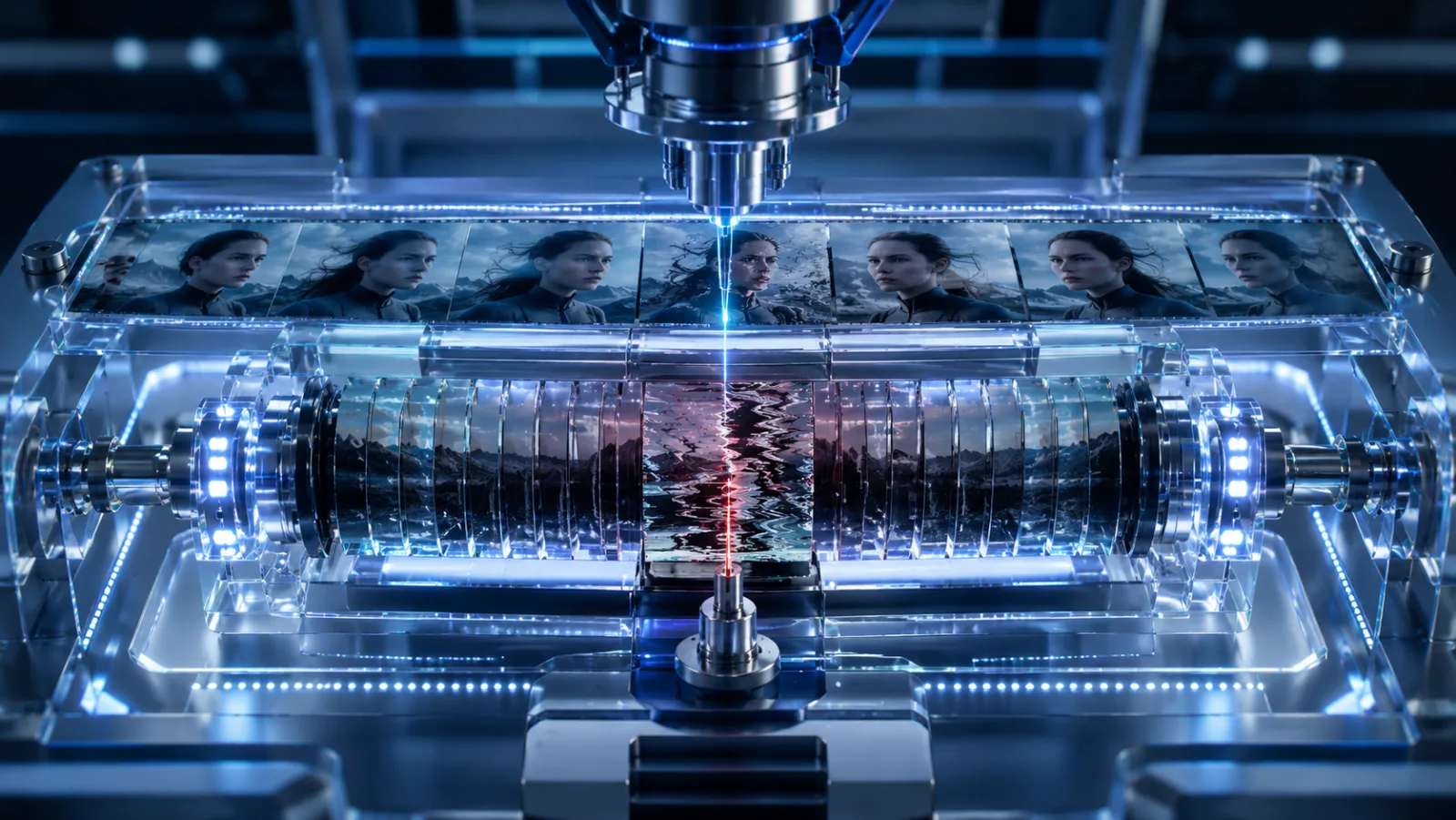
A synthetic training video can look coherent at its beginning and end while losing the target identity somewhere in the middle. The paper proposes changing the synthetic-data factory so that every generated frame is checked against a real target-identity reference, the weakest eligible frame receives an additional identity anchor, and only then is the affected span regenerated.
This turns synthetic-pair creation into a feedback-controlled quality process. Accepted pairs can carry their minimum identity score and anchor history; clips that fail after exhausting a fixed anchor budget can be rejected or labeled as hard cases. A second mechanism applies similar external checking to facial micro-texture, where otherwise plausible outputs may still look over-smoothed.
For an operator, the interesting controls are the identity threshold and anchor budget: together they could define a measurable trade-off among fidelity, yield, and GPU consumption. But the word could is essential. Adaptive Identity Anchoring and its texture-restoration companion are methodological proposals. The paper defines how to test them; it does not report original experiments showing that they outperform fixed or uniformly spaced anchors.
The training target can fail between its endpoints
Video face swapping has an awkward supervision problem: the ideal paired target—one person’s identity performing another person’s recorded motion in the original scene—does not naturally exist. Synthetic pipelines therefore manufacture the target video.
The paper starts from an existing design in which target-identity evidence is supplied at the first and last frames, with the interior synthesized between them. Robbins argues that this boundary-only arrangement leaves potentially long stretches without direct appearance evidence of the target identity.1
The resulting failure is not necessarily a completely broken video. A clip may remain temporally plausible while identity fidelity weakens around a profile view, occlusion, intense movement, or another localized event. If such a clip becomes training supervision, the student is being trained against a manufactured target whose error is itself uneven through time.
That changes the operational question. The issue is not simply how many synthetic pairs can be generated. It is where additional generation effort should be spent when a pair contains a localized defect.
Adaptive Identity Anchoring puts measurement inside the minting loop
The proposed answer is Adaptive Identity Anchoring, or AIA. Instead of fixing all identity reference frames in advance, the pipeline begins with boundary anchors, synthesizes the video, and scores each generated face against an embedding derived from a real photograph of the target identity.
For frame $t$, the proposed identity score is
where $E$ is an identity encoder, $\hat{f}_t$ is the generated frame, and $e_B$ is the embedding of the real target-identity photograph.
The minimum frame-level score becomes the feedback signal. If it falls below an acceptance threshold $\tau$, AIA selects the worst-scoring eligible frame outside guard regions around existing anchors. An image face-swapping model creates a new anchor there, and the relevant span is regenerated. The procedure stops when the minimum score clears the threshold, an anchor budget $K$ is exhausted, or there is nowhere eligible to add another anchor.
The proposed mechanism is constraint density. The authors hypothesize that identity error grows as a frame gets farther from its nearest identity anchor. Shortening those unreferenced spans should therefore constrain drift. More specifically, adaptive placement could beat uniform spacing when failures cluster around particular temporal events rather than appearing evenly throughout a clip.
That relationship is a hypothesis, not a reported result. One of the paper’s proposed experiments is explicitly designed to test whether identity error actually increases with nearest-anchor distance.
The output is more than another synthetic pair
Embedding measurement inside generation also changes what the data factory can record.
An accepted pair can retain its final anchor set, its per-frame score curve, and its minimum identity score. The paper describes these artifacts as a basis for automatic filtering and machine-checkable identity certification. A clip that repeatedly fails can instead be rejected or marked as a hard example.
Operationally, this creates several possible output states rather than a binary generate-and-store workflow:
| Minting outcome | Proposed action | Operational meaning |
|---|---|---|
| Identity score clears threshold | Accept with score and anchor metadata | Pair enters training with recorded QC evidence |
| Local identity failure | Insert anchor and regenerate affected span | Extra compute is targeted at the measured failure |
| Anchor budget exhausted | Reject or flag as hard | Failure becomes visible instead of silently entering the dataset |
| Candidate anchor is poor | Skip insertion | Prevent a weak image-swap anchor from imposing another bad constraint |
Local-span regeneration is important here. The proposal does not require synthesizing an entire clip again after every intervention; it uses regeneration between neighboring anchors as the default. If adaptive placement works as hypothesized, that could concentrate incremental GPU spending on the difficult segment rather than apply an enlarged anchor budget uniformly.
For synthetic-data teams, $\tau$ and $K$ would then become production controls. Raising the threshold could increase desired fidelity while reducing acceptance yield and increasing compute. Increasing the anchor budget could rescue more difficult clips but at additional minting cost. The paper defines this control surface but supplies no measured cost curve.
Identity can pass while the face still looks synthetic
The paper also identifies another defect that an identity referee does not directly solve: over-smoothed facial texture.
Reality-Referenced Texture Restoration, or RTR, extends the external-referee principle beyond identity. It proposes matched sensor-grain synthesis, high-frequency detail transfer from corresponding real footage, and a spectral check that compares the generated face with the real frame.
The spectral score is a log ratio of high-frequency facial energy:
Values close to zero indicate similar high-band energy between generated and real face regions. When identity already passes but texture fails, the proposed loop can target the frame with the largest absolute spectral mismatch.
The significance is architectural rather than cosmetic. A generator’s normal objective may fail to price a particular quality dimension. The paper’s response is to bring in a real-data reference that measures that dimension separately.
That logic has wider relevance to synthetic-data systems: generation and quality assurance need not share the same objective or evaluator.
A certificate inherits the scorer’s blind spots
The closed loop also creates a concentrated measurement risk. If the identity encoder cannot detect an error, optimizing the mint against that encoder will not repair it. Extreme yaw, occlusion, or low resolution could therefore become blind spots of both the scorer and the resulting certificate.
The paper proposes keeping evaluation identity encoders separate from the encoder used inside the minting loop. This is a safeguard against self-certification and Goodharting, not evidence that those risks have been eliminated.
RTR has an analogous boundary. Matching high-frequency energy does not prove that skin texture is natural; synthetic noise can produce similar spectral energy. High-frequency transfer may also carry identity-bearing information if the chosen frequency boundary does not cleanly separate micro-texture from identity.
There is another operational consequence. Rejecting clips that exhaust their anchor budget may improve average accepted-pair quality while systematically removing difficult poses, occlusions, or motion patterns. A cleaner dataset could therefore lose hard-tail coverage.
The seven experiments are the evidence agenda, not the evidence
The paper specifies seven prospective experiments covering the anchor-gap hypothesis, adaptive versus uniform placement, downstream student training, interaction with Identity-Coherence Reinforcement Learning, compute accounting, texture ablations with human judgment, and repeated-generation texture degradation.
These designs are valuable because they make the proposal falsifiable. Uniform and adaptive placement would be compared at matched anchor budgets. Student architecture, data volume, curriculum, and training schedule would be held fixed when comparing minting methods. A separate 2×2 design would test whether better synthetic supervision reduces the marginal value of downstream identity-coherence reinforcement learning.
But none of these experiments is reported as completed original validation.
That boundary governs the business interpretation. AIA offers a credible operating hypothesis: measure every synthetic pair, localize its weakest frame, spend additional compute where the measured defect occurs, and reject outputs that cannot meet a defined quality floor. RTR proposes extending the same pattern to another measurable failure channel.
What remains unknown is whether this produces better training data than cheaper alternatives, how much extra GPU capacity it consumes, whether independent scorers confirm the certificates, and whether downstream models improve enough to justify the added minting complexity.
The proposal therefore moves a useful decision upstream. Synthetic-data quality becomes something the factory can inspect and react to during production, rather than something discovered only after a downstream model has learned from defective supervision. Whether that control loop earns its operating cost is now a testable question.
Cognaptus: Automate the Present, Incubate the Future.
-
Logan Robbins (2026). Adaptive Identity Anchoring: Closed-Loop Keyframe Placement for Synthetic Paired Supervision in Video Face Swapping. arXiv:2607.21434. https://arxiv.org/abs/2607.21434 ↩︎