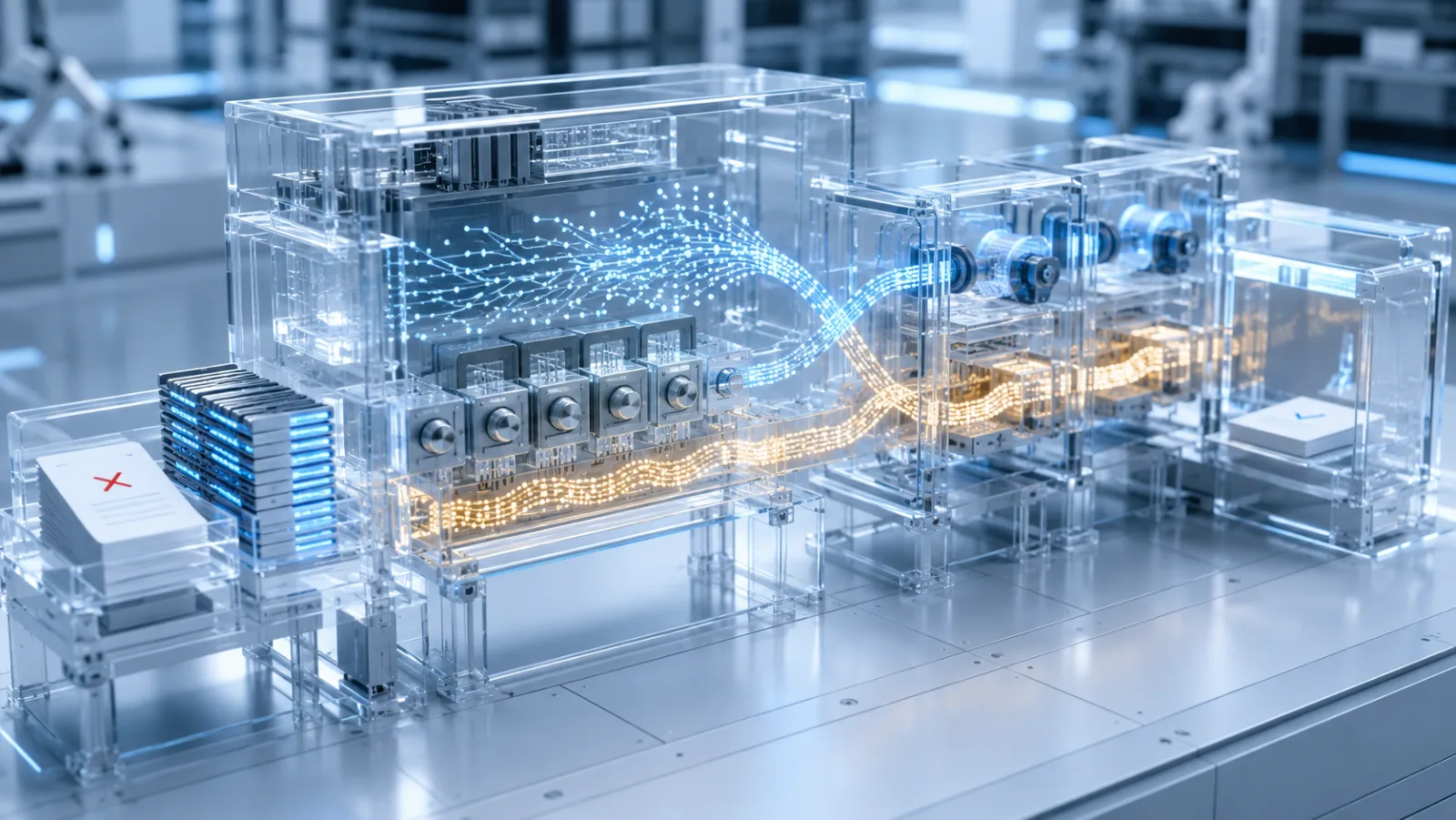
Scores are comforting. They fit neatly into leaderboards, procurement decks, and internal model-comparison spreadsheets. One model gets 71.5, another gets 72.9, and someone in the meeting says, “So the second one reasons better.”
Maybe. Or maybe the model merely passed a particular checkpoint more often. That is useful, but it is not the same as knowing whether the model has learned a controllable reasoning process. A thermometer tells you the patient is hot; it does not explain the infection. Benchmarks are the thermometer. The paper Entropy-Gradient Inversion: Moving Toward Internal Mechanism of Large Reasoning Models tries to look for something closer to the infection mechanism — or, less dramatically, the internal process signature behind “slow thinking” in large reasoning models.1
The paper’s central claim is not simply that a new reinforcement-learning recipe improves math scores. That would be the easy summary, and also the duller one. The more interesting claim is that reasoning models show a distinctive internal relationship between two quantities: token-level entropy and logit-gradient influence. In ordinary base or safety-aligned models, these two quantities do not show the same strong negative relationship. In reasoning models, they do.
The authors call this pattern Entropy-Gradient Inversion. The name is slightly heavy, but the idea is worth the weight: in a mature reasoning model, high-uncertainty branching tokens can have low internal gradient influence, while low-entropy committed steps can carry stronger gradient impact. In other words, high entropy does not always mean the model is “lost.” Sometimes it marks a controlled fork in the reasoning route. The drama is lower than the entropy suggests. Models, apparently, can also look nervous while knowing what they are doing.
The paper is about process evidence, not just better answers
A normal benchmark asks: did the final answer match the expected answer?
This paper asks a more mechanistic question: when the model is generating a reasoning trajectory, how does uncertainty at each token relate to the internal sensitivity of the model’s logits? That turns the object of study from the final answer into the route by which the answer is produced.
The authors define two main measurements.
First, token entropy measures how uncertain the model’s next-token distribution is. In simplified form, if $P(v \mid x_{1:i-1})$ is the model’s probability for vocabulary item $v$ at position $i$, entropy is:
High entropy means the model is spreading probability across more possible next tokens. Low entropy means it is more concentrated.
Second, gradient influence measures how strongly the relevant logit is tied to internal parameter sensitivity. The paper computes gradient matrices for the attention projection components $Q$, $K$, $V$, and $O$, measures them with a nuclear norm, and averages across layers. The details matter for implementation, but the business translation is simpler: gradient influence is treated as a proxy for how much a token is internally “pressing” on the model’s representational machinery.
The authors then compute the Spearman correlation between token entropy and gradient influence. If high-entropy tokens also have high gradient influence, uncertainty and internal sensitivity move together. If high-entropy tokens have low gradient influence while low-entropy tokens have high influence, the relationship flips negative. That negative relationship is the inversion.
The inversion: high-entropy forks, low-gradient disturbance
The paper’s first major evidence compares three Qwen2.5-7B-family variants: a base model, a safety-tuned model, and a reasoning model represented by DeepSeek-R1-Distill-Qwen-7B. The authors test across reasoning, safety, and base sample distributions.
The clearest reported number comes from reasoning samples. The reasoning model shows a strong negative Spearman correlation of $\rho = -0.649$ between token entropy and gradient nuclear norm. The base model shows only a weak negative correlation of $\rho = -0.171$, while the safety-tuned model shows a positive correlation of $\rho = 0.148$.
That contrast is the paper’s first important mechanism claim. A base model tends to treat uncertainty as something that requires greater internal correction. A reasoning model, according to the authors’ interpretation, has internalized enough structure that high-entropy branching tokens do not necessarily produce large gradient disturbance. The model can entertain multiple next steps without destabilizing its internal route.
This is where the common misconception matters. In many product discussions, entropy is treated as a warning light: high entropy equals confusion; reduce it whenever possible. That is too crude. In reasoning, some uncertainty is not noise. It can be a branching point.
A useful replacement distinction is this:
| Reader belief | Correction from the paper | Why it matters operationally |
|---|---|---|
| High entropy means the model is confused. | In reasoning models, high-entropy branching tokens can have low gradient influence. | Do not automatically suppress all uncertainty; inspect where it occurs in the reasoning route. |
| Low entropy means the model is safe. | Low entropy can correspond to committed steps with higher gradient influence. | Confident steps may be the ones most worth checking, because they can anchor the route. |
| Final accuracy is enough to evaluate reasoning. | The paper treats reasoning as an internal trajectory with measurable geometry. | Enterprise evaluation can move from answer checking toward process diagnostics. |
The point is not that entropy is “good.” That would be just as lazy as saying entropy is “bad.” The point is that entropy has to be read together with internal influence. A model that explores possible reasoning steps while keeping the internal structure stable is different from a model that simply flails with a large vocabulary distribution.
The training story: SFT starts the inversion, RL deepens it
The second contribution is a training-dynamics story. The authors track when the inversion appears during a DeepSeek-R1-style training pipeline: supervised fine-tuning first, then GRPO reinforcement learning.
For Qwen2.5-7B, the reported Spearman correlation starts around the base level of $-0.171$. During SFT, it drops to about $-0.308$ within the first 200 steps and reaches $-0.494$ by step 8000. After GRPO reinforcement learning, it further converges to $-0.556$.
That sequence is important because it separates two functions often mixed together in casual RL discussions. SFT appears to establish the reasoning trajectory structure. RL then reinforces and sharpens it.
The paper also examines a pure-RL path, similar to an R1-Zero-style setup. Without the SFT warm-up, the correlation oscillates during early training and converges only to $-0.318$. That does not mean pure RL is useless. It means that, in this setup, pure RL produces a weaker and less stable inversion signature than the SFT-plus-RL pipeline.
The appendix repeats the tracking experiment on Llama3.1-8B. This is best read as a robustness check, not a second thesis. The reported pattern is similar: SFT rapidly creates the inversion, pure RL is less stable, and RL after SFT strengthens the signal. The evidence is broader than one Qwen run, but not universal across all possible model families, tasks, or post-training recipes.
CorR-PO turns the fingerprint into a reward penalty
Once the paper identifies the inversion as a diagnostic signature, it makes the obvious next move: instead of merely observing the signature, use it during training.
The proposed method, Correlation-Regularized Group Policy Optimization, or CorR-PO, modifies GRPO by adding an internal correlation regularization term to the reward. The authors segment a generated reasoning sequence into reasoning steps, compute average step entropy, compute gradient influence, and then calculate the Spearman correlation $\rho_{E,I}$ between the two arrays.
The correlation reward is:
Because $\rho_{E,I}$ lies between $-1$ and $1$, this reward term lies between $-2$ and $0$. It is a penalty, not a competing bonus. The total reward is:
The engineering intent is clean: keep the ordinary accuracy reward, but penalize trajectories that do not show the desired entropy-gradient inversion. The model is still rewarded for being correct, but it is also nudged toward a latent structure associated with reasoning-model behavior.
This matters because many reasoning-training recipes depend heavily on external verifiers. External verification is powerful when answers are formally checkable, as in math. It becomes much less convenient when business tasks involve contracts, financial memos, policy interpretation, customer complaints, or messy operational exceptions. CorR-PO does not solve that general problem directly. It does, however, point toward a training philosophy: use internal process signals to supplement outcome rewards.
The main results are positive, but the appendix makes them more interesting
The performance results should be read carefully. The headline is not “CorR-PO crushes everything.” It does not. The more accurate reading is: CorR-PO improves over strong baselines in the main Qwen2.5 experiments, remains competitive in Qwen3 extensions, and shows training-dynamics evidence consistent with the proposed mechanism.
| Evidence | Likely purpose | What it supports | What it does not prove |
|---|---|---|---|
| Figure 2: base/safety/reasoning correlation comparison | Main mechanism evidence | Reasoning models show a stronger negative entropy-gradient relationship than base or safety-tuned variants. | That all reasoning-capable models must show the same signature. |
| Figure 3: SFT and RL training dynamics | Main mechanism evidence | SFT rapidly establishes the inversion; RL strengthens it. | That pure RL can never produce strong reasoning, or that SFT is always necessary. |
| Tables 1–2: Qwen2.5 performance | Main performance evidence | CorR-PO improves average benchmark performance over GRPO-family baselines on Qwen2.5-7B-Math and Qwen2.5-14B. | That CorR-PO dominates all methods across all architectures. |
| Figure 4 and Appendix F: training-process comparison | Mechanism-performance alignment | Stronger inversion under CorR-PO coincides with better average performance over training steps. | A complete causal proof that the correlation alone causes reasoning improvement. |
| Table 3: learning rate and $\lambda_{corr}$ | Sensitivity test | CorR-PO is not extremely fragile across tested hyperparameters; stronger correlation penalty helps in the best setting. | That hyperparameter behavior will generalize to larger models or non-math tasks. |
| Appendix C: Llama3.1-8B training dynamics | Robustness check | The SFT/RL inversion pattern is not confined to Qwen2.5. | That the phenomenon is architecture-independent in general. |
| Appendix E: Qwen3-4B and Qwen3-1.7B | Model-scale extension | CorR-PO remains competitive beyond the main Qwen2.5 setup. | That CorR-PO always beats the best baseline. It ties on Qwen3-4B and ranks second on Qwen3-1.7B. |
| Appendix G: layer-wise training | Ablation | Single-layer signals help, deeper layers are stronger, and full multi-layer aggregation is justified. | That a single universal layer can be used across all models. |
On Qwen2.5-7B-Math, CorR-PO reaches an average score of 69.4 across AIME24, MATH500, and GSM8k metrics. That beats GSPO at 68.6 and GRPO at 67.0. On Qwen2.5-14B, CorR-PO reaches 72.9, above Dr.GRPO’s 71.5.
The Qwen3 appendix is more mixed, and therefore more useful. On Qwen3-4B, CorR-PO ties GRPO at 79.8 average, while leading on some GSM8k metrics. On Qwen3-1.7B, CorR-PO reaches 67.1, behind GRPO’s 68.6 but ahead of DAPO, GSPO, and Dr.GRPO. That is not a failure; it is a boundary. The method seems meaningful, but not magically dominant. Very inconsiderate of reality not to obey a cleaner slogan.
The training-process tables are especially relevant. CorR-PO improves from 65.8 at RL-100 to 70.1 at RL-1000, while GRPO reaches 67.0 early and later fluctuates between 63.6 and 66.8. This supports the paper’s claim that the correlation regularizer improves training stability and later-stage gains, rather than merely grabbing an early lucky checkpoint.
The appendix tests robustness, not a second thesis
The appendix adds three useful interpretive layers.
First, the Llama3.1-8B experiment checks whether the inversion dynamics are specific to Qwen2.5. The answer is: probably not, at least within the tested setup. The same broad pattern appears: SFT creates the inversion, RL deepens it, and pure RL is more unstable.
Second, the Qwen3 experiments test whether the performance result survives architecture and scale changes. Here the answer is more cautious. CorR-PO remains competitive, but the gains are not uniformly superior. This is exactly the kind of appendix result business readers should not skip, because it prevents the method from being oversold as a universal upgrade button.
Third, the layer-wise ablation asks whether the gradient signal is concentrated in a particular transformer depth. The paper computes the correlation reward from only one attention layer at a time across 28 layers. Every single-layer variant improves average Pass@1 over the base model’s 50.9, while the best single layer, layer 28, reaches 59.6. Deeper layers tend to provide stronger supervision, but the full multi-layer aggregation still outperforms any single-layer version.
That is a useful implementation clue. The inversion is not a tiny artifact hiding in one fragile layer. It appears to be distributed enough to be measured at arbitrary depth, yet aggregated layer information is still better. For model-training teams, that means the signal is not absurdly brittle. For model buyers, it means nothing unless the vendor can actually expose or measure similar internal diagnostics.
The business value is process control, not a new magic score
For Cognaptus readers, the practical takeaway is not “go implement CorR-PO tomorrow.” Most firms are not training large reasoning models from scratch, and even fewer have convenient access to token-level gradients across attention projections. The more useful business interpretation is about process control.
The paper suggests a three-level maturity model for reasoning AI evaluation:
| Evaluation level | What is measured | Business strength | Business weakness |
|---|---|---|---|
| Output score | Did the final answer pass? | Easy to compare and explain. | Misses unstable or lucky reasoning routes. |
| Trace behavior | Did the reasoning text look coherent? | More informative than final answer alone. | Chain-of-thought text can be unfaithful or selectively polished. |
| Internal diagnostic | Does the model show a stable internal reasoning signature? | Moves evaluation closer to process assurance. | Requires internal access, specialized instrumentation, and careful validation. |
Entropy-Gradient Inversion belongs to the third level. It is not a user-facing confidence score. It is not a citation. It is not a prettier chain-of-thought transcript. It is an internal signature that may help identify whether a model is developing the geometry associated with deliberate reasoning.
This has several business pathways.
For enterprise model evaluation, the paper supports asking vendors more precise questions. Not “what is your benchmark score?” but “what internal diagnostics do you use to distinguish reasoning competence from benchmark-fitting?” Most vendors will answer with a slide. That is fine. Slides are the ceremonial clothing of uncertainty. But the better vendors should be able to explain process-level diagnostics, not only output-level tests.
For custom model training, the paper suggests that internal regularizers can supplement external verifiers. In domains where answer verification is expensive or incomplete, internal process signals may become part of the training stack. This is especially relevant for firms building specialized reasoning systems for finance, engineering, legal operations, scientific workflows, or complex customer-support escalation.
For AI governance, the paper encourages a shift from static acceptance tests to training and deployment telemetry. A model that scores well at launch may drift, fail under new distributions, or overfit to a narrow evaluation suite. Internal diagnostics can become one part of a monitoring system. Not the whole system. One part. Governance is not improved by replacing one simplistic metric with a more exotic simplistic metric.
What the paper directly shows, and what Cognaptus infers
The distinction matters because this paper is strong, but not infinite.
| Category | Statement |
|---|---|
| Directly shown by the paper | Reasoning models in the tested setup show a stronger negative correlation between token entropy and gradient influence than base or safety-tuned variants. |
| Directly shown by the paper | In the tested Qwen2.5 pipeline, SFT rapidly creates the inversion and RL strengthens it. |
| Directly shown by the paper | CorR-PO improves main Qwen2.5 benchmark averages and shows more stable training dynamics than GRPO in the reported runs. |
| Directly shown by the paper | Qwen3 extensions are competitive but not uniformly superior; Qwen3-4B ties GRPO and Qwen3-1.7B trails GRPO. |
| Cognaptus inference | Internal reasoning diagnostics can become useful enterprise evaluation artifacts, especially when final answers are insufficient evidence. |
| Cognaptus inference | Vendor due diligence should increasingly ask about process-level model diagnostics, not only benchmark leaderboards. |
| Still uncertain | Whether Entropy-Gradient Inversion generalizes to non-math business reasoning, long-horizon agent workflows, legal judgment, finance workflows, or multimodal reasoning. |
| Still uncertain | Whether black-box users can approximate this diagnostic without gradient access. |
This separation prevents a common failure mode in AI commentary: turning a technical paper into a product promise. The paper offers a mechanism and a training method. It does not hand procurement teams a turnkey reliability certificate.
Boundaries that matter before business deployment
The first boundary is task scope. The experiments focus mainly on mathematical reasoning benchmarks: AIME24, MATH500, and GSM8k. These are valuable because answers can be verified, but they are not the same as enterprise reasoning over policy exceptions, messy contracts, supplier negotiations, or ambiguous compliance scenarios.
The second boundary is model access. Entropy-Gradient Inversion depends on internal quantities, especially gradient-related measurements. Many enterprise users consume models through APIs. They cannot inspect attention-projection gradients. For them, this paper is more useful as a vendor-evaluation lens than as an immediately deployable metric.
The third boundary is statistical reporting. The paper’s checklist states that explicit error bars or significance tests are not reported, with the authors citing the compute cost of multi-run LLM RL training. The trends are supported across models and benchmark views, but the absence of explicit uncertainty estimates should temper strong claims about small differences. A 0.8-point average advantage can matter, but it should not be worshipped. Small deltas have started many unnecessary meetings.
The fourth boundary is causality. CorR-PO’s reward intervention strengthens the case that the inversion is operationally useful, but the relationship between inversion strength and reasoning performance is still not a complete causal map. The signal may be a good fingerprint, a useful training prior, and a partial mechanism indicator at the same time. Those are related roles, not identical ones.
The useful shift: from answer trust to route inspection
The paper’s deeper value is not the acronym. It is the shift in evaluation grammar.
A model answer can be correct while the internal route is fragile. A reasoning trace can sound polished while failing to reflect the real computation. A benchmark score can improve while hiding instability. Entropy-Gradient Inversion does not solve all of that, but it pushes evaluation toward a better question: what internal structure accompanies reliable reasoning?
For business AI, that question is overdue. Firms are already moving from chatbots toward agents, workflow copilots, automated analysts, and decision-support systems. In these settings, reasoning failure is rarely a single bad answer in isolation. It is usually a route failure: the system selects the wrong premise, commits too early, ignores an exception, or keeps exploring without converging.
A process-control view treats reasoning as a staged operation. Inputs enter. Candidate paths branch. Certain steps commit. Verification checks intervene. Final outputs are released only after the route has been inspected. Entropy-Gradient Inversion fits naturally into that worldview because it treats reasoning quality as something measurable inside the route, not merely visible at the exit.
The practical lesson is simple enough: do not trust reasoning because it is fluent, long, or benchmark-decorated. Trust it only after the route has been made inspectable. The paper gives one possible internal fingerprint for that route. It is not the whole map, but it is a useful mark on the wall.
And in a market still very fond of calling every fluent paragraph “reasoning,” a useful mark on the wall is progress.
Cognaptus: Automate the Present, Incubate the Future.
-
Junyao Yang, Chen Qian, Kun Wang, Linfeng Zhang, Quanshi Zhang, Yong Liu, and Dongrui Liu, “Entropy-Gradient Inversion: Moving Toward Internal Mechanism of Large Reasoning Models,” arXiv:2605.17770, 2026, https://arxiv.org/abs/2605.17770. ↩︎