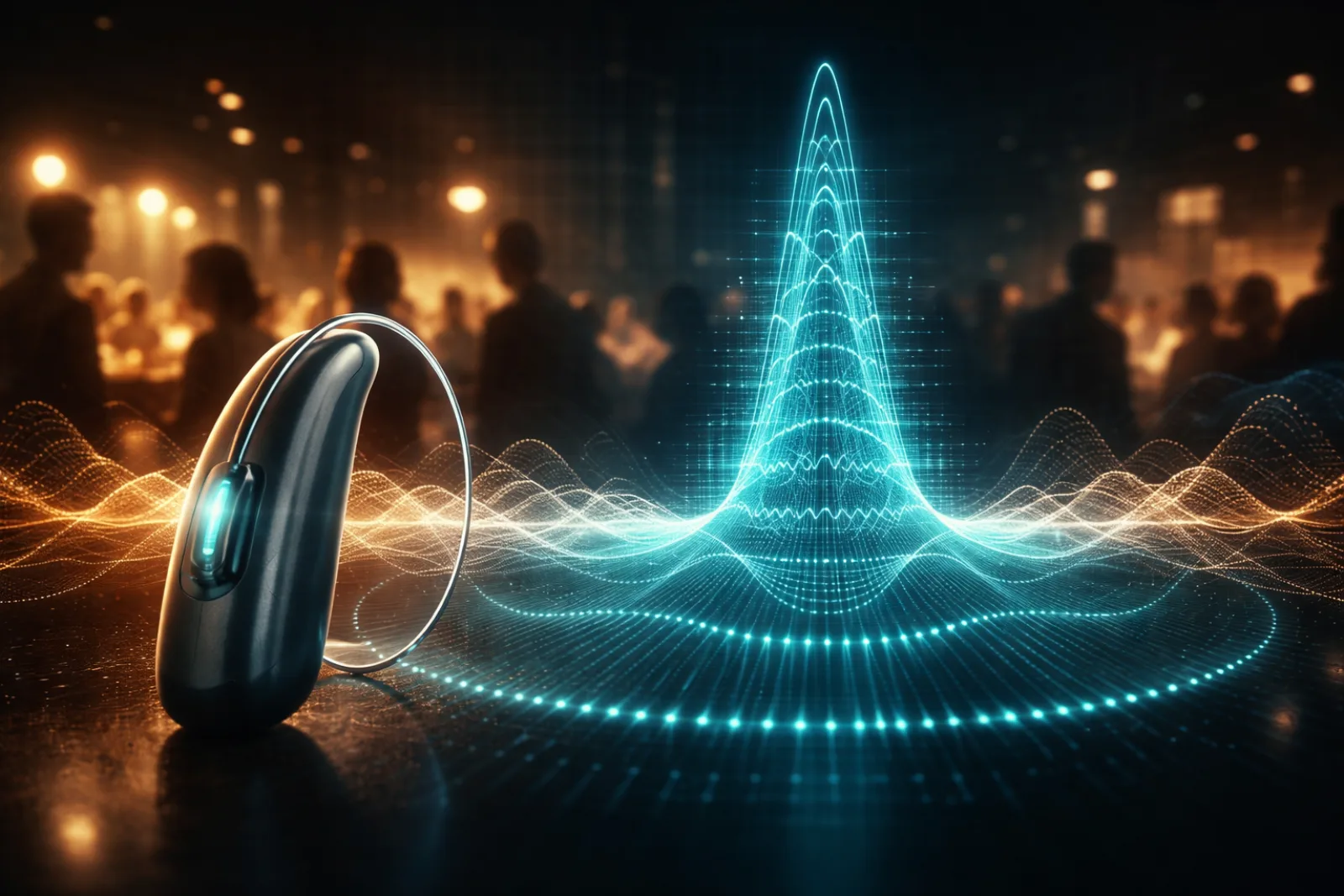
Noise is easy. Attention is hard.
A hearing aid can amplify sound, suppress background noise, and sharpen speech. That is useful, but it does not solve the real cocktail party problem. In a crowded room, the device still has to answer a less mechanical question: which speaker is the listener actually trying to hear?
That is where auditory attention decoding, or AAD, enters the story. The idea is elegant enough to seduce engineers and dangerous enough to embarrass product managers: use EEG signals to infer which speaker a person is attending to, then let the hearing device enhance that stream. In theory, the hearing aid becomes not merely an acoustic amplifier but an attention-aware assistant. In practice, EEG is noisy, attention shifts, speech overlaps, and the signal arrives wearing a very cheap disguise.
The paper Scattering Transform for Auditory Attention Decoding by René Pallenberg, Fabrice Katzberg, Alfred Mertins, and Marco Maass studies a deceptively specific question: what happens if AAD systems stop feeding neural networks the usual compressed envelope features and instead use a two-layer scattering transform for both audio and EEG preprocessing?1
That sounds like a preprocessing paper. It is more interesting than that.
The common instinct in AI product discussions is to assume that better performance comes from a stronger model: a deeper network, a fancier attention block, a graph module, a larger training set, or, because this is 2026 and everyone must pay tribute to the altar, something agentic. This paper quietly points in a different direction. For AAD, the bottleneck may not be the classifier first. It may be the representation handed to the classifier.
The message is not “scattering transform beats everything, please ship it next quarter.” The paper is more useful than that. It shows where richer signal representation helps, where it does not, and why evaluation design can make a method look more deployable than it really is. In other words, the paper is not only about hearing the right speaker. It is about hearing the right evidence.
The old pipeline compresses speech before the model gets a fair chance
Most neural AAD pipelines still begin with a familiar sequence. Audio is passed through an auditory-inspired gammatone filterbank, envelopes are extracted, compressed, summed, filtered between low frequencies, and downsampled. EEG is rereferenced, cleaned for eye artifacts, bandpass filtered, and downsampled. The resulting features are then passed to a model that tries to decide which audio stream better matches the listener’s neural response.
This is sensible engineering. It is also a lossy bargain.
The envelope is attractive because the brain tracks speech rhythm. But an envelope-focused pipeline compresses the audio signal into low-frequency modulation information. That makes the learning problem smaller, but it also discards time-frequency structure that may matter: nested amplitude modulations, local transient patterns, cross-scale dynamics, and the way speech energy changes inside already-modulated speech.
That last phrase sounds annoying because the phenomenon is annoying. Speech is not just “energy over time.” It contains structure inside structure. Phonemes, syllables, words, prosody, speaker timbre, and acoustic transitions all live on different temporal scales. EEG responses are also not stationary little obedience machines. They vary across subjects, channels, frequencies, attention conditions, and recording quality.
So the paper’s central mechanism is straightforward: before asking a neural network to identify attention, give it a representation that preserves more of the multiscale structure that attention may actually track.
The scattering transform does this by applying wavelet filters, modulus nonlinearities, and low-pass averaging in layers. The first layer behaves like a wavelet-based time-frequency decomposition. The second layer then captures modulations of those modulations. That is the key phrase. The second layer is not merely a wider filterbank. It is intended to encode second-order temporal structure that conventional envelope extraction and first-order representations miss.
A blunt comparison helps:
| Representation choice | What it mostly gives the model | What it risks losing | Business interpretation |
|---|---|---|---|
| Conventional envelope pipeline | Compact speech envelope and filtered EEG | Fine-grained nested modulation structure | Cheap and familiar, but may underfeed the model |
| Regular filterbank / first-order representation | Richer frequency decomposition | Second-order modulation dynamics | More channels, not necessarily more useful information |
| SSQ-STFT | Sharper time-frequency localization | Hierarchical modulation structure | Technically elegant, but not the same mechanism as scattering |
| Two-layer scattering transform | Multiscale and second-order temporal features | Higher preprocessing cost and latency | Potentially better attention signal, but hardware must pay the bill |
The important distinction is between “more input channels” and “more informative structure.” A lazy reading of the paper would say: scattering transform helps because it creates more features. The paper spends real experimental effort undermining that lazy reading. Good. Someone had to.
The second layer is the thesis, not a decorative extra
The authors compare the scattering pipeline with three alternatives: the conventional baseline pipeline, a regular filterbank-like setup, and synchrosqueezed short-time Fourier transform, or SSQ-STFT. They test these preprocessing choices across multiple neural architectures, including CNN-C1, CNN-Dil, LSTM-2, LSTM-X, GCANet, and a modified GCANet-NoEn variant adapted for transformed inputs.
This is not just model shopping. Each model family creates a different compatibility test.
CNN-style models test whether scattering features work with convolutional correlation-style architectures. LSTM models test whether compact recurrent models can exploit the transformed sequence. GCANet-NoEn tests whether a modern graph/cross-attention architecture can perform well when its original encoders are replaced by transformed representations.
The paper’s core empirical claim is that the two-layer scattering transform can significantly improve AAD performance in subject-related settings, especially on the KUL dataset. In trial-wise subject-wise experiments, the conventional baseline fails to exceed median accuracies of 0.64 on either dataset. The scattering transform and SSQ-STFT improve performance on KUL across nearly all models, with mean accuracies reaching up to 0.92. On DTU under the stricter cross-validation setting, improvements are much more selective: GCANet-NoEn and LSTM-X show substantial gains, while baseline and SSQ-STFT largely remain at chance level.
That asymmetry matters. A method that works everywhere is a platform. A method that works under specific dataset and evaluation conditions is a research result with business potential. Confusing the two is how roadmaps become folklore.
The speaker-wise KUL evaluation is where the scattering transform becomes most interesting for deployment thinking. Speaker-wise evaluation asks whether the system can handle speakers not seen during training. That is closer to a real hearing-aid scenario than simply testing on neighboring windows from the same trial. In this setting, all tested models benefit strongly from scattering features. LSTM-2 and GCANet-NoEn often perform slightly better than the others, although not always significantly.
The strongest mechanism test appears in the second-layer analysis. The authors vary the scattering output frequency. The second scattering layer is active only under specific configurations, particularly for EEG at lower output frequencies. When the second layer is active at 8 Hz and 16 Hz, the LSTM-2 model achieves strong improvements. The paper reports a median accuracy of 0.88 for LSTM-2 at 16 Hz and 8 Hz, compared with 0.57 at 32 Hz under a configuration where the second layer does not provide the same benefit.
This is not presented as a magical frequency choice. The authors interpret it as evidence that the active second layer contributes information beyond parameter count. They give three reasons. First, simply multiplying the number of channels without the second-layer benefit does not improve performance. Second, some larger configurations show overfitting: training accuracy rises above 90%, while validation performance does not improve. Third, configurations with similar or even fewer input channels but an active second layer perform better.
That is the paper’s most business-relevant technical point: representation quality beats representation volume. The device does not win by dumping more coefficients into a network. It wins if those coefficients preserve the structure that distinguishes the attended speaker from the ignored one.
A model can only learn from what preprocessing refuses to throw away. Yes, this sentence is obvious. Apparently it still needed an experiment.
The main evidence is not all doing the same job
The paper contains several experimental pieces, and they should not be read as one undifferentiated accuracy parade. Different tests serve different purposes.
| Paper component | Likely purpose | What it supports | What it does not prove |
|---|---|---|---|
| Trial-wise subject-wise evaluation on KUL and DTU | Main evidence under subject-specific training | ST improves performance strongly on KUL and selectively on DTU | Universal generalization across datasets |
| Speaker-wise KUL evaluation | Deployment-relevant generalization test for unseen speakers | ST helps when test speakers are unknown | Cross-subject commercial readiness |
| Second-layer and output-frequency tests | Ablation / mechanism test | Gains are linked to second-order scattering information, not just more parameters | Optimal parameter settings for all hardware and users |
| Filter-per-octave variation | Sensitivity test | Reducing both audio and EEG scattering resolution can hurt performance substantially | A final compression recipe for embedded devices |
| Cross-subject evaluation | Scalability stress test | ST does not solve user-to-user generalization | Fully personalized hearing aids are unnecessary |
| FLOP and latency analysis | Deployment feasibility check | ST is plausible but computationally nontrivial | Immediate low-power product integration |
This separation matters because business readers are tempted to extract one headline number and turn it into strategy. The paper does not justify that. Its results are conditional, and the conditions are exactly where the insight lives.
For KUL, the scattering transform looks very strong in subject-wise and speaker-wise settings. For DTU, the picture is harder. The authors explain the DTU-KUL difference through training-data availability and dataset properties. DTU has more attention changes, shorter stable attention contexts, and multiple acoustic environments. The paper reports that increasing the training data through k-fold cross-validation improves DTU results substantially: for example, LSTM-2 rises from 0.60 under the primary cross-validation setting to 0.84 under 5-fold cross-validation, while GCANet-NoEn rises from 0.78 to 0.94.
That does not mean the strict evaluation was unfair. It means it was testing a harsher and more practical question: can a model perform when user-specific data is limited?
For real products, that question is not academic. Nobody wants to sit through a long EEG calibration ritual so their hearing aid can eventually understand dinner. AAD only becomes attractive if setup burden is tolerable. The paper’s use of Dietterich-style cross-validation, with only half the data used for training in each split, may underestimate the ceiling performance of some models. But it also pressures the system in a way that resembles deployment reality.
The annoying evaluation protocol is part of the value.
GCANet-NoEn and LSTM are the practical pair to watch
The model comparison is easy to misread. One might expect the most modern architecture to dominate. The results are more nuanced.
GCANet-NoEn is the most consistently attractive model in the paper because it works well with scattering features across datasets and evaluation strategies. The modification removes original encoding blocks and adapts transformed EEG and audio features into the remaining GCANet cross-attention structure. In effect, the scattering transform takes over part of the representation work that the network would otherwise have to learn.
That matters operationally. The paper reports that GCANet baseline has about 70M FLOPs and 3M weights for the model itself, while GCANet-NoEn with scattering has about 50M model FLOPs and roughly 1.3M to 1.4M weights, depending on scattering settings. The transformed representation reduces learned-network complexity, even though the preprocessing adds cost.
LSTM models are the other interesting result. LSTMs are no longer fashionable in many deep-learning conversations, which makes them useful. Fashion is not a benchmark. LSTM-2 performs strongly with scattering in several settings, and the paper notes that LSTM-based approaches can require far fewer model-side FLOPs than GCANet-NoEn. LSTM-2 with scattering is reported around 4M to 4.5M model FLOPs, compared with 50M for GCANet-NoEn.
The catch is preprocessing. The scattering transform itself costs about 44M FLOPs for a one-second window under the standard setting discussed in the paper: about 20M per audio signal and 4M for all 64 EEG channels. The conventional gammatone envelope calculation is estimated around 5.5M FLOPs. So the scattering transform moves work from the learned model into signal processing. That may still be a good trade, but it is not free.
The business question is therefore not “Which neural network wins?” It is:
Should the product spend compute on a smarter front end so that the classifier receives a cleaner, richer attention signal?
For hearing-aid and assistive-audio firms, that is a hardware-software co-design question. It touches chip capability, battery life, latency, thermal budget, user calibration burden, and how much of the pipeline can be optimized through sparse wavelet computation or dedicated accelerators. The paper mentions that FFT/IFFT operations are highly optimized and that commercial hearing-aid chips and programmable AI accelerators suggest feasibility. Still, feasibility is not the same as product readiness. Engineers are paid to know the difference. Sometimes.
The real product value is not higher accuracy; it is lower personalization pain
The direct result of the paper is technical: two-layer scattering features improve AAD performance in several subject-wise and speaker-wise settings, especially on KUL, and GCANet-NoEn with scattering is the most robust combination across the reported conditions.
The business inference is more specific: scattering transforms may reduce the amount of model learning needed to extract useful auditory-attention structure from small, noisy, user-specific datasets.
That distinction is essential. For a hearing-aid company, average benchmark accuracy is not the final product metric. The real metrics look more like this:
| Product question | How this paper helps | Remaining uncertainty |
|---|---|---|
| Can the system adapt to a user with limited calibration data? | Strict cross-validation emphasizes performance under reduced training data | Some subjects still remain near chance |
| Can it handle unfamiliar speakers? | Speaker-wise KUL results show strong ST gains for unknown speakers | DTU cannot test this because it has only two speakers |
| Can it run in a device? | FLOP and delay analysis gives a first feasibility map | Real embedded latency, battery, and memory tests are not performed |
| Can one model serve many users? | Cross-subject tests directly examine this | ST does not solve cross-subject generalization |
| Is the gain just bigger input? | Second-layer tests argue against the parameter-count explanation | Parameter optimization remains incomplete |
The most important business implication is not “build EEG hearing aids now.” It is “stop treating preprocessing as a commodity layer.”
In many AI products, especially those built around biological, acoustic, sensor, or industrial signals, the model is only the visible part of the system. The representation layer determines what the model is allowed to notice. In text AI, this lesson appears as chunking, retrieval, document parsing, and metadata design. In AAD, it appears as signal transforms.
Different domain, same embarrassment: the expensive model often inherits the cheap assumptions of the preprocessing pipeline.
Cross-subject generalization remains the wall
The cleanest limitation in the paper is also the most commercially important one: scattering transform does not solve cross-subject generalization.
In cross-subject evaluation, models are trained on some subjects and tested on unseen subjects. This is the dream scenario for scale. If it worked well, firms could train a broadly useful model and reduce individual calibration. The paper does not show that. On KUL cross-subject tasks, median accuracies do not exceed 0.7, and the authors explicitly state that ST does not make neural networks function well across subjects.
That boundary should not be softened. It changes the product interpretation.
A deployable AAD hearing-aid system may still need user-specific calibration, adaptation, or online learning. Scattering features may make that calibration more efficient or more accurate, but the paper does not prove that one universal decoder can be shipped to all users. For firms, the roadmap should therefore focus less on “one model for everyone” and more on hybrid personalization:
- a strong signal representation front end;
- a compact user-adapted classifier;
- hardware-aware computation;
- short calibration protocols;
- continuous adaptation under privacy constraints.
The subject variability results reinforce this. The paper observes two rough groups of subjects: one group where models remain around 0.4 to 0.6 accuracy, and another where they reach roughly 0.75 to 1.0. Intermediate cases are rare. That pattern suggests a product risk: the same pipeline may feel impressive for some users and useless for others.
The authors raise the possibility that this could reflect either subject differences or recording quality. From a product perspective, both explanations are inconvenient in different ways. If it is subject-specific neurophysiology, personalization is harder. If it is recording quality, sensor design and fitting become critical. Either way, the model cannot be evaluated in isolation from the device and user experience.
The latency bill is measurable, not fatal
Scattering transforms cost compute and introduce delay. The paper estimates that wavelet filters can add up to 0.5 seconds of delay in the longest EEG path under one configuration, with total delay potentially reaching about one second after network computation. That is not a rounding error for real-time listening.
But latency in AAD is not the same as latency in ordinary audio playback. EEG responses already lag behind auditory stimuli, so some delay is structurally unavoidable. The question is not whether the system has delay. The question is whether the additional delay still allows useful steering of enhancement in conversation.
The paper notes possible mitigation strategies: increase output frequency to reduce delay, omit low frequencies, reduce filters per octave, exploit FFT/IFFT optimization, and use sparse bandpass coefficients. Those are plausible engineering levers. They are not yet a product specification.
A useful product roadmap would treat the paper’s computational section as an early design budget:
| Engineering lever | Likely benefit | Risk |
|---|---|---|
| Reduce filters per octave | Lower preprocessing and model cost | Accuracy can drop if both EEG and audio resolution are reduced |
| Use 16 Hz rather than 8 Hz output | Lower delay | May affect second-layer information and model behavior |
| Replace heavy encoders with ST front end | Fewer learned parameters | Preprocessing FLOPs increase |
| Use compact LSTM classifier | Lower model compute | May underperform modern cross-attention in some settings |
| Hardware acceleration | Real-time feasibility | Battery and integration constraints remain untested |
The boring answer is the correct one: scattering transforms are not “too expensive” or “ready to ship.” They are a candidate representation layer that deserves hardware-aware optimization.
What Cognaptus would take from this paper
The paper directly shows that two-layer scattering transforms can improve auditory attention decoding compared with conventional preprocessing, regular filterbank-style alternatives, and SSQ-STFT in several important settings. The strongest evidence appears in subject-wise and speaker-wise evaluations on KUL, while DTU results are more dependent on model choice and training-data volume. GCANet-NoEn plus scattering is the most robust combination across the paper’s reported conditions.
Cognaptus would infer three broader lessons.
First, in sensor-AI products, preprocessing is not plumbing. It is part of the model’s intelligence. The representation layer can create or destroy the learning opportunity before the neural network begins.
Second, evaluation design is strategic, not clerical. Full-shuffle style evaluation can inflate confidence by allowing neighboring windows and local trial patterns to leak into performance estimates. Trial-wise, speaker-wise, and cross-subject splits ask harder questions. Those harder questions are closer to business reality.
Third, the best product design may not use the biggest classifier. A stronger front-end representation plus a compact adapted classifier may be more attractive than an end-to-end architecture that learns everything from scarce user data. The paper does not prove that this is always true. It makes the hypothesis credible enough to test seriously.
For hearing-aid companies, the next step is not a press release. It is a controlled product-oriented experiment: same users, realistic noisy environments, short calibration, embedded compute constraints, and online adaptation. The benchmark should include not only accuracy but also delay, battery impact, failure cases by subject, and subjective listening improvement.
In other words, the question should move from “Can the model classify attended speech in a dataset?” to “Can the device improve a real conversation before the user gets irritated?”
A small distinction. Only the difference between a paper and a product.
Conclusion: the second order is where the product argument begins
The most useful idea in this paper is not that scattering transforms are fashionable. They are not. That may be part of their charm.
The useful idea is that AAD performance may be limited by what conventional envelope preprocessing erases. Two-layer scattering transforms preserve second-order modulation structure that appears relevant for matching speech and EEG in attention decoding. In the paper’s experiments, that richer representation produces meaningful gains, especially for subject-specific and unknown-speaker settings on KUL, while exposing the stubborn limits of cross-subject generalization and embedded compute.
That is exactly the kind of result business teams should like: promising, bounded, and slightly inconvenient.
It does not say that EEG-driven hearing aids are solved. It says the path to solving them may run through better signal representation before larger neural architectures. For a field that often confuses model complexity with progress, that is a useful correction.
The cocktail party problem will not be fixed by making everything louder. It may be helped by listening to the second order.
Cognaptus: Automate the Present, Incubate the Future.
-
René Pallenberg, Fabrice Katzberg, Alfred Mertins, and Marco Maass, “Scattering Transform for Auditory Attention Decoding,” arXiv:2602.23003, 2026, https://arxiv.org/html/2602.23003. ↩︎