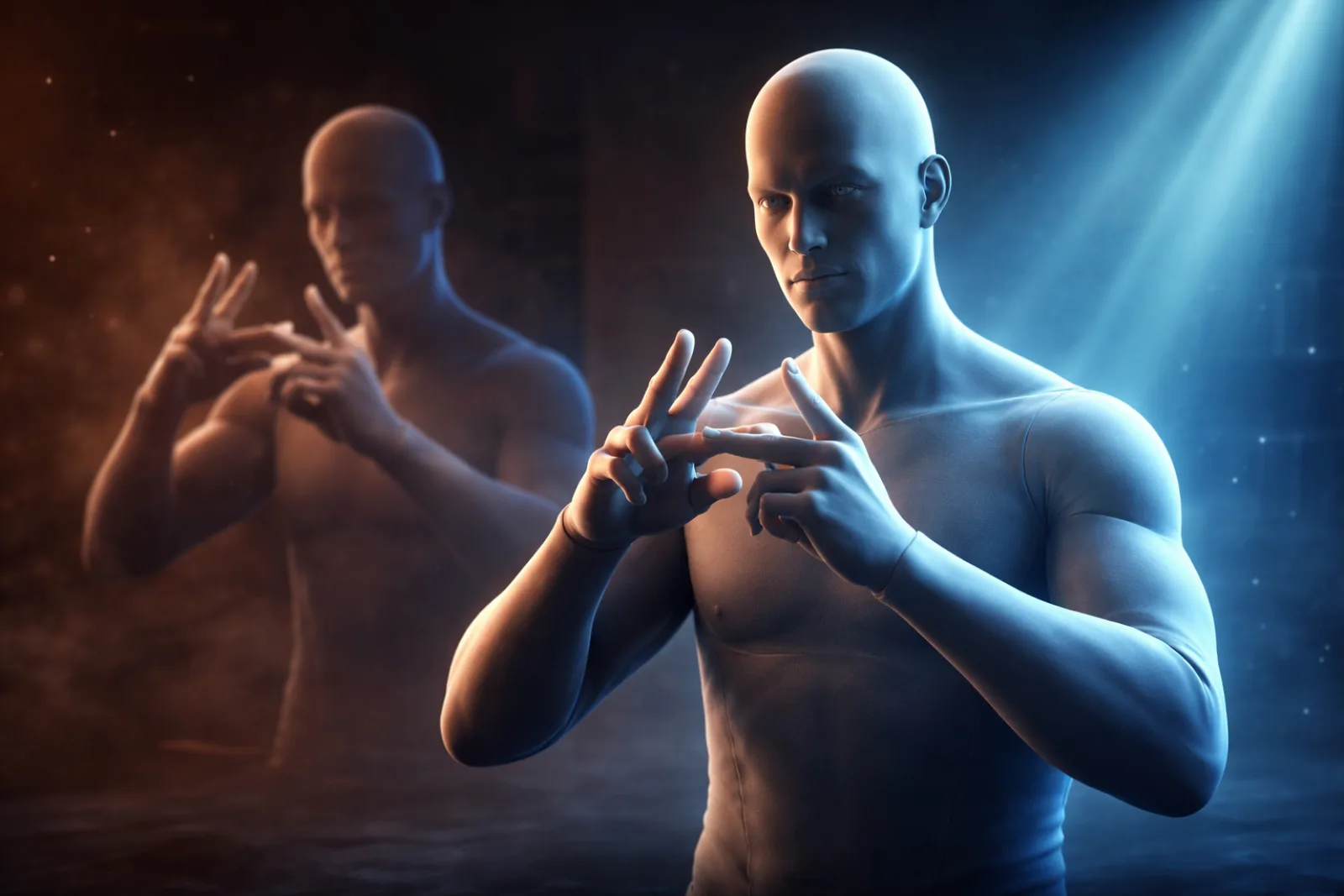
Hands are small, fast, and inconvenient.
That is a problem for AI systems that prefer the world to be large, slow, and conveniently labeled. A walking person can be reconstructed with some tolerance for imprecision. A signer cannot. In sign language, a curled finger, wrist angle, palm orientation, or moment of hand-body contact may carry meaning. When the model gets that wrong, it is not merely producing an awkward avatar. It is quietly changing the message.
The paper behind DexAvatar makes this point through a technical route: 3D sign-language avatar reconstruction from monocular video.1 The phrase sounds niche. It is not. It sits at the uncomfortable intersection of accessibility technology, human-pose estimation, synthetic data, avatar interfaces, and the industry’s favorite superstition: that more general models eventually absorb every special case by statistical osmosis.
Lovely theory. Sign language, as usual, refuses to cooperate.
DexAvatar’s central lesson is not “we need a better avatar model.” The sharper lesson is that some domains are not solved by generic perception plus scaling. They require priors that understand what the motion is allowed to mean.
DexAvatar reconstructs signing; it does not translate signing
The first useful correction is simple: DexAvatar is not a sign-language translation system. It does not take English text and generate signing. It does not claim to understand full linguistic meaning. It does not solve the social, linguistic, or cultural challenge of sign-language communication. That would be a much larger paper, and probably a louder one.
DexAvatar addresses a narrower but foundational task: given monocular video of someone signing, reconstruct a plausible 3D signing avatar. The output is a 3D body-and-hand pose sequence, represented through a parametric human model, not a translated sentence.
That distinction matters because many business readers will instinctively place this paper in the “AI accessibility assistant” bucket. That is too broad. The more accurate bucket is “3D infrastructure for sign-language media and datasets.” If reconstruction improves, downstream tools can build better signing avatars, cleaner motion datasets, more realistic educational material, more reliable telepresence systems, and eventually better generation models. But the paper itself is about recovering 3D signing motion from video.
So the article should not be read as “AI now understands sign language.” It should be read as “AI may stop mangling the fingers before trying to understand the language.” A modest ambition, but an overdue one.
The failure begins with 2D evidence that cannot see depth
Most sign-language datasets are video-based. They often include 2D keypoints, because 2D pose extraction is cheaper and easier than full 3D motion capture. That makes sense operationally. It also creates the central ambiguity.
A 2D hand keypoint is a shadow. Different 3D hand configurations can cast a similar 2D projection. A finger may be curled toward the camera or extended in a different depth plane. Two hands may touch, overlap, or occlude each other. A wrist may rotate in a way that is barely visible from one camera angle but still meaningful to the sign.
For generic human-pose estimation, this ambiguity is annoying. For sign language, it is existential. Signing uses a compact 3D space in front of the torso, with frequent hand-hand and hand-body interactions. The hands are not decorative endpoints attached to arms. They are primary linguistic instruments.
This is why monocular reconstruction is hard: the model sees a 2D signal, then must infer a 3D body. When the visual evidence is weak, the model leans on its prior. The prior becomes the model’s common sense.
And if the prior was trained mostly on everyday human motion, its “common sense” may be wrong.
Generic pose priors solve the wrong problem politely
Generic 3D pose models are not stupid. They are trained to produce plausible human bodies. That is exactly the issue.
A generic prior may know that humans wave, walk, reach, sit, and turn. It may know that elbows do not fold backward and that fingers should not melt into the palm. But sign language needs a more specific kind of plausibility. The pose must be anatomically possible, spatially consistent with signer space, and precise enough for communication.
Those are not the same constraint.
A generic model can produce a hand that looks human but is linguistically wrong. It can smooth away sharp motion. It can over-regularize unusual finger shapes. It can treat hand-body contact as noise. It can resolve occlusion by choosing the most common everyday pose rather than the correct signing pose.
This is where DexAvatar’s mechanism-first framing becomes useful. The paper is not just adding another model to the leaderboard. It diagnoses a mismatch:
| Reconstruction problem | Generic system tendency | Why signing breaks it |
|---|---|---|
| 2D keypoints under depth ambiguity | Choose a statistically plausible 3D body | Multiple signing poses may share similar 2D projections |
| Fast hand motion | Smooth or blur the articulation | Speed is part of natural signing, not merely noise |
| Self-occlusion | Guess visible body structure from common poses | Hand overlap and body contact are frequent linguistic events |
| Unusual finger configuration | Pull pose toward generic hand priors | Valid signs can require configurations underrepresented in everyday-motion data |
| One-handed signing | Still update the inactive limb | The inactive hand should often stay irrelevant, not be hallucinated into activity |
This is a familiar AI business lesson wearing a pair of motion-capture gloves: the prior is not background machinery. It is the model’s policy for uncertainty.
DexAvatar repairs the pipeline by narrowing what counts as plausible signing
DexAvatar keeps the broad architecture of optimization-based 3D reconstruction, but changes what the optimization is allowed to prefer. The system uses SMPL-X as the expressive body model and starts from off-the-shelf estimates, including body pose, hand pose, camera parameters, and 2D keypoints. Then it refines them with sign-language-aware priors and biomechanical constraints.
The paper’s two named priors are SignHPoser for hands and SignBPoser for body. Both are variational autoencoder priors. In plain terms, they learn compact latent spaces for poses that are likely under signing rather than under generic human motion.
The body prior, SignBPoser, is trained from 3D body data derived from How2Sign through SignAvatars, then filtered using biomechanical constraints. The filtering focuses on the joints that matter most for signing: shoulders, elbows, forearms, and wrists. The goal is not to model the whole body with equal enthusiasm. Signing usually does not require lower-body drama. There is no need for the model to discover interpretive dance in the knees.
The hand prior, SignHPoser, is trained from new sign-language motion-capture data collected with a Vicon camera setup and Manus gloves. The dataset includes fingerspelling from eight signers: six proficient in Auslan and two fluent in ASL. The raw hand data are corrected using biomechanical constraints on bending, splaying, and twisting across hand joints before training.
The important design move is not merely “train a prior.” It is “do not train the prior on garbage and then act surprised when it learns garbage elegantly.”
| Component | What it learns or enforces | Why it matters operationally |
|---|---|---|
| SignHPoser | Fine-grained hand articulations from corrected sign mocap | Reduces implausible or semantically damaging finger shapes |
| SignBPoser | Upper-body signing motion within plausible signer space | Prevents generic body priors from pulling signing into irrelevant motion patterns |
| Biomechanical filtering | Removes or corrects implausible training poses | Improves the data distribution before the model learns from it |
| Temporal consistency | Penalizes unstable frame-to-frame jumps | Keeps reconstructed signing coherent across video |
| One-handed decision logic | Disables optimization of inactive non-dominant limbs | Reduces hallucinated motion where the video does not support it |
This is the repair mechanism: DexAvatar does not try to overpower ambiguity with a larger generic model. It narrows the search space to poses that make sense for signing.
The optimization step is where the priors become useful
DexAvatar is optimization-based. That detail matters for business interpretation.
A regression model predicts 3D pose directly in one forward pass. It can be fast, but it has less room to negotiate conflicting evidence. An optimization-based pipeline can start from noisy estimates, then iteratively adjust the body and hands to minimize a loss function. That makes it easier to add task-specific terms: 2D reprojection error, interpenetration penalties, prior losses, temporal consistency, and biomechanical constraints.
In DexAvatar, the generic VPoser body prior is replaced with SignBPoser, and SignHPoser is added for the hands. The system also suppresses lower-body optimization because signing is mainly upper-body. For one-handed signs, it disables the inactive side to avoid spurious refinement.
That is not a glamorous design choice. It is a practical one. Many AI systems fail not because their core model is weak, but because they keep optimizing parts of the world that should have been held constant. When the non-dominant hand is irrelevant, “letting the model decide” is not freedom. It is an invitation to hallucinate.
The optimization objective therefore does something business teams should recognize: it encodes operational knowledge directly into the system. The model is not just learning from examples. It is being constrained by what the task is allowed to be.
The main benchmark result is strongest where generic models drift most
The paper evaluates DexAvatar on the SGNify motion-capture benchmark: 57 German signs, evaluated on 2,872 central frames. The metric is TR-V2V error in millimeters, computed over mesh vertices above the pelvis, with separate reporting for upper body, left hand, and right hand. Lower is better.
The headline result is clear: DexAvatar reports the best performance among the compared methods.
| Method | Upper Body excluding face | Left Hand | Right Hand |
|---|---|---|---|
| FrankMoCap | 78.07 | 20.47 | 19.62 |
| PIXIE | 60.11 | 25.02 | 22.42 |
| PyMAF-X | 68.61 | 21.46 | 19.19 |
| SMPLify-SL | 56.07 | 22.23 | 18.83 |
| SGNify | 55.63 | 19.22 | 17.50 |
| OSX | 47.32 | 18.34 | 18.12 |
| Neural Sign Actors | 46.42 | 16.17 | 15.23 |
| EVA* | 40.38 | 13.73 | 13.68 |
| DexAvatar | 30.13 | 13.53 | 13.08 |
The upper-body result deserves the most attention. DexAvatar reduces upper-body error from 46.42 mm for Neural Sign Actors to 30.13 mm, which the paper reports as a 35.11% improvement. That is not a cosmetic gain. It suggests that sign-aware constraints are changing the reconstruction regime, not merely polishing the mesh.
The hand results require a more careful reading. Against Neural Sign Actors, DexAvatar improves left- and right-hand errors from 16.17 mm and 15.23 mm to 13.53 mm and 13.08 mm. That is meaningful. Against EVA*, however, the hand gains are much smaller: 13.73 to 13.53 on the left, and 13.68 to 13.08 on the right.
This does not weaken the paper. It sharpens it. DexAvatar’s evidence is not “everything becomes dramatically better everywhere.” The more precise interpretation is that domain-specific priors produce a large improvement in upper-body signing reconstruction and smaller but still favorable gains in hand reconstruction against the strongest modified baseline. A serious article should not pretend otherwise. Numbers are allowed to be interesting without being inflated.
The ablations show that better data correction beats louder regularization
The ablation studies are where the paper becomes more useful than a leaderboard.
For SignBPoser, the authors compare body-prior variants trained on unfiltered data, biomechanically filtered data, and filtered data with an added biomechanical loss during prior training. The key pattern is that filtering the training data matters. The filtered body prior reduces upper-body-related errors compared with the unfiltered prior.
| Body-prior variant inside DexAvatar | Full Body | Upper Body | Upper Body without head | Upper Body excluding face |
|---|---|---|---|---|
| Trained on unfiltered body data | 43.18 | 29.95 | 44.72 | 34.06 |
| Trained on biomechanically filtered body data | 42.32 | 26.78 | 41.35 | 30.28 |
| Filtered data plus biomechanical loss during prior training | 42.38 | 26.93 | 41.88 | 30.44 |
The lesson is almost rude in its simplicity: cleaning the data distribution before training helped more than adding another constraint during prior training. The filtered-data prior is better than the unfiltered-data prior across the reported subsets. Adding a biomechanical loss on top of filtered data during prior training slightly degrades the reported table values.
The paper then notes that adding biomechanical loss during the final fitting optimization, while retaining the filtered prior, gives the best result, but the extra reductions are small: 0.17% for full body, 0.37% for upper body, 0.05% for upper body without head, and 0.33% for upper body excluding face. That is not a second grand discovery. It is a tuning gain.
The hand-prior ablation tells a similar story.
| Hand-prior variant inside DexAvatar | Upper Body excluding face | Left Hand | Right Hand |
|---|---|---|---|
| Trained on uncorrected hand data | 31.34 | 14.19 | 13.92 |
| Trained on biomechanically corrected hand data | 30.17 | 13.55 | 13.06 |
| Corrected data plus hand biomechanical loss | 30.13 | 13.53 | 13.08 |
Correcting the hand mocap data improves all three reported metrics. Adding the biomechanical regularizer produces tiny additional gains on upper body and left hand, while right-hand error slightly worsens compared with the corrected-only variant.
That is exactly the kind of result business teams should learn to love: not spectacular, but diagnostic. It says the expensive part is not merely inventing another model component. It is building the right data-generation and data-cleaning process before training. In high-precision domains, preprocessing is not janitorial work. It is product design.
The qualitative tests are stress evidence, not a second benchmark
The paper also presents qualitative comparisons on difficult signing cases: motion blur, self-occlusion, and Gaussian noise. These are useful, but they should be classified correctly.
They are not a quantified robustness benchmark. They are qualitative stress evidence. Their purpose is to show how the system behaves when the visual signal degrades in ways that are common in signing video.
| Evidence type | Likely purpose | What it supports | What it does not prove |
|---|---|---|---|
| Main SGNify benchmark table | Main quantitative evidence | DexAvatar lowers TR-V2V error against compared baselines on the available benchmark | Generalization across all sign languages, cameras, and signing styles |
| SignBPoser ablation | Ablation | Biomechanical filtering of body data improves reconstruction | That stronger constraints always help |
| SignHPoser ablation | Ablation | Correcting hand mocap data improves hand and upper-body reconstruction | That the hand prior is fully language-general |
| Hyperparameter sweeps in supplement | Implementation and sensitivity evidence | Prior training is reasonably stable under tested latent sizes and constraint weights | That the method is insensitive to all deployment settings |
| Ground-truth quality discussion | Evaluation-boundary analysis | Benchmark labels can contain implausible hands, limiting how much TR-V2V rewards plausible corrections | That qualitative plausibility should replace quantitative evaluation |
| Blur, occlusion, and noise examples | Qualitative robustness evidence | DexAvatar often preserves hand contact and finger structure under difficult images | Production reliability under uncontrolled video streams |
This distinction matters because AI articles often turn qualitative figures into exaggerated claims. DexAvatar’s supplemental examples are valuable because they match the mechanism: when keypoints become unreliable, the sign-specific prior helps the optimizer choose a plausible signing pose. But without a large quantified stress benchmark, they should not be sold as proof of deployment-grade robustness.
The paper is stronger when interpreted precisely. It shows that the mechanism behaves sensibly under difficult cases. It does not show that every webcam, signer, dialect, lighting condition, and signing speed is now solved. Humanity may continue breathing.
The benchmark itself has a strange but important boundary
One of the most interesting parts of the supplementary material is the discussion of SGNify ground-truth limitations. The authors note that the benchmark ground truth sometimes contains implausible hand configurations, including collapsed fingers and irregular knuckle spacing.
This creates an evaluation paradox. If the reference mesh is anatomically flawed, a method that produces a more plausible hand may not always receive a better vertex-distance score. TR-V2V measures distance to the reference, not truth in any philosophical sense. The metric is useful, but it can punish a model for correcting an error that exists in the benchmark.
This does not invalidate the reported results. DexAvatar still performs best on the benchmark. But it does affect how we read the smaller hand improvements. Some gains may be constrained by the reference quality. If the ground truth contains distorted fingers, then a plausibility-aware model may visually look better while receiving only modest numeric reward.
For business teams, this is a familiar evaluation problem. In domains where labels are noisy, the metric may understate the value of a model that follows real-world constraints. Conversely, qualitative plausibility can be subjective. The correct response is not to abandon metrics. It is to design evaluations that separate geometric closeness, anatomical validity, and linguistic correctness.
That third category—linguistic correctness—is especially important here. DexAvatar evaluates reconstruction, not whether Deaf signers judge the avatar as understandable or natural. For accessibility products, that eventual user evaluation cannot be optional. A low mesh error is not the same as communicative adequacy.
The business value is accessibility infrastructure, not a plug-and-play product
DexAvatar’s business relevance is best understood as infrastructure.
Better 3D reconstruction can support several practical workflows: converting existing signing videos into 3D motion assets, improving avatar-based educational material, building datasets for future sign-language generation systems, enabling richer telepresence, and improving customer-service avatars where sign-language support is required.
But the paper directly shows only the reconstruction layer. Cognaptus would interpret the business pathway as follows:
| Layer | What the paper directly shows | Business inference | Remaining uncertainty |
|---|---|---|---|
| 3D reconstruction | Lower mesh reconstruction error on SGNify and better qualitative hand-body plausibility | Existing signing videos may become more usable as 3D training or animation assets | Performance across broader languages, signers, and recording conditions |
| Avatar production | More plausible body and hand poses from monocular video | Lower manual cleanup cost for sign-language avatar pipelines | Whether the output is natural and acceptable to Deaf users |
| Synthetic data | Sign-specific priors can stabilize difficult poses | Reconstruction could help create cleaner datasets for downstream generation | Risk of encoding biases from small signer groups or imperfect priors |
| Accessibility interfaces | Better 3D signing motion is a prerequisite for usable signing avatars | Customer support, education, and telepresence tools may become more realistic | Translation, timing, facial expression, and cultural-linguistic validity remain separate problems |
| Enterprise deployment | Optimization-based system can incorporate constraints transparently | More controllable than a black-box regression-only model in high-precision settings | Runtime cost and engineering complexity may be non-trivial |
This is not a “ship it next quarter” paper. It is a “your avatar stack is missing a domain-specific reconstruction layer” paper.
That difference is not pessimism. It is product hygiene.
The limits are narrow enough to be useful
The paper’s limitations are not vague academic throat-clearing. They materially affect deployment interpretation.
First, the main benchmark is small: 57 German signs and 2,872 evaluated central frames. That is a serious evaluation for a specialized task, but it is not proof of global sign-language coverage.
Second, the hand prior is trained from fingerspelling data collected from eight signers, involving Auslan and ASL proficiency. Fingerspelling is valuable for fine hand articulation, but it is not the same as full continuous signing across many languages, dialects, body types, speeds, and expressive styles.
Third, the body prior relies on filtered pseudo-ground-truth body data derived from existing reconstruction pipelines. Filtering helps, but pseudo-ground truth remains a dependency, not magic.
Fourth, the method is optimization-based and evaluated using an RTX 4090 setup. That does not automatically disqualify production use, especially for offline reconstruction or dataset creation. But it does mean we should not assume real-time consumer deployment without further engineering.
Fifth, DexAvatar focuses on pose and mesh reconstruction. Sign language also depends on facial expressions, timing, rhythm, gaze, body posture, and cultural-linguistic context. SMPL-X can represent face and body, but this paper’s core evidence is about body and hand reconstruction. A signing avatar that moves accurately but lacks appropriate non-manual markers can still fail communication.
These boundaries do not make the paper weak. They make the contribution legible. DexAvatar advances a specific layer of the stack. It should not be punished for not solving the entire stack, and it should not be advertised as if it did.
The deeper lesson: domain priors are not optional when errors change meaning
The AI industry often talks about “generalization” as if the world were a single distribution waiting for a large enough model to swallow it. DexAvatar is a useful objection.
Sign language is not merely human motion with smaller fingers. It is structured communication through the body. That means the reconstruction problem is not only geometric. It is constrained by what signers can plausibly produce and what viewers may plausibly interpret.
DexAvatar works because it changes the model’s uncertainty behavior. When the video is ambiguous, the system does not fall back to generic human motion. It falls back to sign-aware body and hand priors, corrected with biomechanical knowledge and used inside an optimization pipeline that knows which limbs matter.
That is the durable business lesson. In high-precision domains, the winning system is often not the largest generic model. It is the system that knows which errors are cheap and which errors destroy meaning.
For sign-language avatars, dexterity is not decoration. It is the interface.
Cognaptus: Automate the Present, Incubate the Future.
-
Kaustubh Kundu, Hrishav Bakul Barua, Lucy Robertson-Bell, Zhixi Cai, and Kalin Stefanov, “DexAvatar: 3D Sign Language Reconstruction with Hand and Body Pose Priors,” arXiv:2512.21054. ↩︎