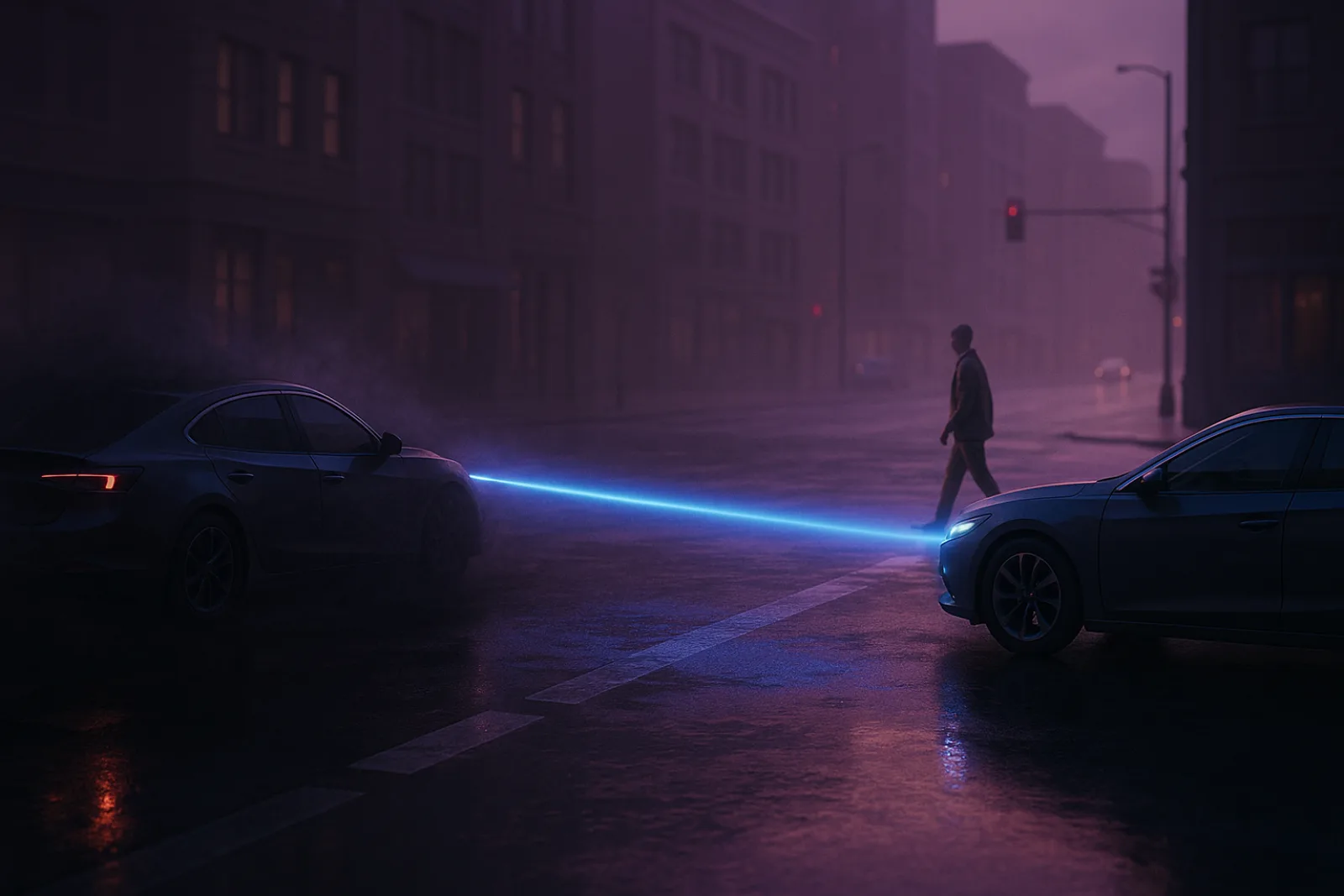
Left turn, blocked view, bad timing
Start with the boring part of driving: a car waiting to turn left.
The ego vehicle has LiDAR. It has a perception stack. It has a clean mathematical confidence score and, presumably, a dashboard that looks more expensive than the problem deserves. But a parked vehicle, a bus, or a line of traffic blocks the view. Somewhere beyond that occlusion, an oncoming vehicle may be approaching. The autonomous system does not need to know everything about the city. It does not need every neighboring car to livestream its sensors like a nervous influencer. It needs one missing fact: is there something dangerous inside the blind zone?
That is the useful entry point into SRA-CP: Spontaneous Risk-Aware Selective Cooperative Perception.1 The paper is not merely another cooperative perception architecture trying to squeeze a few more points out of a benchmark. Its sharper idea is operational: connected vehicles should not cooperate continuously, globally, or generously. They should cooperate when a blind spot is risky, with whichever nearby vehicle can actually see into that blind spot, and by transmitting only the feature cells that matter under a byte budget.
That sounds obvious only after someone says it. Which is how many good systems papers behave.
The common misconception is that cooperative perception means “more vehicles sharing more sensor data.” SRA-CP replaces that with a less romantic but more deployable principle: communication is a scarce safety resource. Spend it where occlusion and collision risk overlap.
Cooperative perception is not a group livestream
Cooperative perception, or CP, exists because a single vehicle’s sensors are physically limited. Cameras and LiDAR can only observe what their placement, range, line of sight, weather conditions, and surrounding geometry allow. If another connected vehicle sees what the ego vehicle cannot, sharing perception data can help the ego vehicle detect occluded cars, pedestrians, cyclists, or other road users earlier.
In the laboratory version of this story, the solution is straightforward: connect the agents, fuse their information, and enjoy the enlarged field of view. In deployment, this becomes much less charming.
The paper emphasizes two bottlenecks. First, perception data is large. Intermediate features extracted from onboard sensors at 5–20 Hz can reach around 2 MB per frame, creating potential transmission rates on the order of hundreds of Mbps in dense settings. A system where every vehicle shares full perception data with every other nearby vehicle is therefore not a safety architecture. It is a denial-of-service attack with wheels.
Second, many CP frameworks assume predefined communication partners or controlled zones. That may work for a testbed with a fixed set of vehicles. It does not fit ordinary traffic, where connected vehicles meet briefly, unpredictably, and often without any prior relationship. Most encounters do not require cooperation at all. The paper cites prior work suggesting that only a tiny fraction of driving situations actually require CP. The rest is over-sharing, and over-sharing is expensive.
Selective CP methods already try to reduce this burden by sending only spatially useful regions. Where2Comm, used as a baseline in this paper, is the representative example: select the BEV cells that appear informative for perception and transmit those instead of everything. Sensible. But spatial usefulness is not the same as safety relevance. A distant or easy-to-handle object may improve a detection metric without changing the driving decision. A partially hidden vehicle crossing the ego’s intended path is different.
SRA-CP is built around that difference.
SRA-CP starts with a cheap whisper, then asks for help
The paper’s protocol has two modes.
In routine mode, each connected vehicle broadcasts only lightweight information: its position, velocity, and perception coverage map. This coverage map summarizes which bird’s-eye-view cells are visible and which are likely occluded. It is not raw point cloud sharing. It is closer to saying, “Here is what I can currently see.”
In triggered mode, the ego vehicle uses those coverage summaries to decide whether cooperation is needed. If it detects a risky blind zone, it checks whether any nearby connected agent has coverage that can compensate for that zone. If such a partner exists, the ego initiates an ad-hoc CP request. If no suitable partner exists, the vehicle falls back to its own perception and must behave conservatively, such as stopping or continuing to observe.
The sequence is simple enough to be useful:
| Stage | Question answered | Data exchanged | Operational meaning |
|---|---|---|---|
| Routine broadcast | Who can see which region? | Coverage map, pose, velocity | Low-cost situational awareness |
| Risk identification | Is my blind zone relevant to driving safety? | Local computation | Avoids unnecessary CP |
| Partner selection | Who can help with this blind zone? | Coverage comparison | Makes cooperation spontaneous |
| Selective sharing | Which cells are worth transmitting? | Sparse feature cells guided by spatial and risk masks | Controls bandwidth |
| Dual-attention fusion | How should ego merge the incoming features? | Fused BEV representation | Recovers critical occluded objects |
This is the paper’s first contribution: SRA-CP turns cooperative perception from a standing agreement into an event-triggered negotiation. The vehicle does not ask everyone for everything. It asks the right neighbor for the right missing region.
That matters because autonomous driving is full of temporary, asymmetric perception failures. One car is blind because a truck blocks its view; another car has a clear line of sight from a different angle. SRA-CP exploits that asymmetry without assuming permanent communication groups.
Risk is a filter before it is a detector
The paper’s risk model is deliberately pragmatic. It estimates where occlusion matters for the ego vehicle’s driving task.
The blind-zone model is based on BEV visibility. LiDAR points are projected into a 2.5D occupancy field, and line-of-sight transmittance is modeled along rays. Cells outside the sensor’s field of view or blocked by occupancy become likely blind-zone cells. The authors then stabilize the blind-zone mask across recent frames to reduce flicker.
The risk labels combine three components:
| Risk component | Intuition | Why it matters |
|---|---|---|
| Distance-based risk | Closer objects are usually more urgent | Immediate collision relevance |
| Speed-based risk | Fast or relatively fast objects create dynamic hazards | Captures closing risk |
| Intersection-based risk | Intersections create conflict points and occlusions | Adds traffic-context awareness |
The final risk score is clipped and used to construct dense risk heatmaps. These are not presented as a universal theory of traffic risk. They are a workable training and selection signal for OPV2V experiments, refined with domain knowledge.
This distinction matters. The paper is not claiming that risk can be completely solved by distance, speed, and intersection proximity. It is showing that even a structured, relatively simple risk signal can make communication more useful than spatial saliency alone. In business terms, the important part is not the exact formula. The important part is the shift from “which region improves perception?” to “which unseen region could change the driving decision?”
That is a better question.
The technical trick is to spend bytes where spatial difficulty and collision risk overlap
Once cooperation is triggered, SRA-CP uses a risk-aware selective information sharing and fusion model. Each vehicle encodes its LiDAR sweep into BEV features using a PointPillar-style backbone. Two lightweight heads then generate two maps:
- a spatial confidence map, which highlights semantically informative regions;
- a risk confidence map, which highlights traffic-safety-relevant regions.
Under a per-link byte budget, the system selects top feature cells using these signals. The paper’s strongest version uses a union gate, combining spatial and risk cues rather than relying on either alone. The selected feature cells are transmitted and then fused by the ego vehicle through a dual-attention module.
The reason this matters is not architectural decoration. Spatial-only selection and risk-only selection fail differently.
Spatial-only selection can transmit regions that are geometrically or semantically interesting but not urgent. It is a good student of perception metrics, not necessarily of traffic conflict. Risk-only selection can over-focus on danger zones while losing contextual support needed for reliable fusion. It may know where the fire is but forget the building.
The union strategy is more practical: preserve enough spatial context to fuse features correctly while emphasizing zones that matter for safety. In the paper’s language, bandwidth should be concentrated on cells that are both hard for the ego vehicle to perceive and relevant to risk.
That is the second contribution: SRA-CP treats communication selection as a joint spatial-risk allocation problem, not a generic feature compression problem.
Ordinary AP is the wrong headline
The experiments use OPV2V, a synthetic multi-vehicle cooperative perception benchmark generated from OpenCDA co-simulation with SUMO and CARLA. The dataset includes scenarios such as lane changes, intersections, merging, crossroads, head-on encounters, straight driving, and multi-agent cooperation. The authors use 64-channel LiDAR and evaluate 3D object detection with AP at IoU thresholds 0.3, 0.5, and 0.7.
The baselines are well chosen for the paper’s claim:
| Method | Role in the experiment |
|---|---|
| Upper Bound / fully connected CP | Performance ceiling with full communication |
| Where2Comm / spatial-only | Strong selective CP baseline without explicit risk awareness |
| Fixed-neighbor equal-budget | Tests whether adaptive partner/content selection matters |
| Random-cell | Tests whether selected content matters at all |
| Lower Bound / single-agent | No-communication floor |
The standard AP table is useful, but it is not where the paper earns its title.
At 20% of full communication volume, SRA-CP reaches AP30/AP50/AP70 of 0.8920/0.8731/0.7979. The fully connected upper bound reaches 0.9057/0.8955/0.7996. Where2Comm reaches 0.8902/0.8791/0.7928. In plain English: on aggregate object detection, SRA-CP is close to full CP and broadly comparable to spatial-only selective CP.
That is still valuable. It says the proposed method does not destroy general detection performance while cutting bandwidth sharply. But it also warns us not to over-read the standard AP result. If the business question is “which method gets the best average detection score across all objects?”, SRA-CP is not a dramatic revolution. It is competitive.
The paper becomes more interesting when the evaluation asks the safety question: what happens to high-risk objects?
Risk-filtered AP is where the argument becomes sharper
The authors evaluate Risk-Aware AP by filtering objects according to risk thresholds. This is the correct evaluation move. If the model’s purpose is safety-relevant communication, average AP across all objects is a diluted metric. A method can look good on ordinary objects while failing precisely where assistance matters.
At risk threshold 0.4, the difference becomes clear:
| Method | Risk-AP30 | Risk-AP50 | Risk-AP70 |
|---|---|---|---|
| Upper Bound | 0.5003 | 0.4994 | 0.4704 |
| SRA-CP | 0.4963 | 0.4955 | 0.4702 |
| Where2Comm | 0.4701 | 0.4553 | 0.4177 |
| Fixed-neighbor | 0.3610 | 0.3565 | 0.3171 |
| Random-cell | 0.3737 | 0.3685 | 0.3238 |
| Lower Bound | 0.3631 | 0.3581 | 0.3111 |
This table is doing most of the intellectual work.
SRA-CP stays almost on top of the fully connected upper bound for high-risk objects while operating at only 20% of the communication volume. Where2Comm, despite being strong on overall AP, drops more noticeably under risk filtering. Fixed-neighbor and random-cell selection sit near the lower bound, which is a polite way of saying that arbitrary communication is not cooperation; it is bandwidth cosplay.
The paper’s abstract-level claim is that SRA-CP achieves less than 1% AP loss for safety-critical objects compared with generic CP while using only 20% of the bandwidth, and improves critical-object AP over selective CP methods that do not incorporate risk awareness. The detailed tables support the direction of that claim: the advantage is not that SRA-CP magically detects everything better. The advantage is that it spends its limited communication budget where detection failure would matter most.
That is a much more useful result.
The byte-efficiency tests answer a procurement question
The paper then runs two evaluation protocols that are closer to deployment thinking than ordinary benchmark tables.
Protocol P1 fixes bandwidth and asks: under scarce communication, which method gives the best detection performance? Across the 0.5–10 KB/frame regime, SRA-CP traces the stronger Pareto frontier. The authors report, for example, that at 5 KB/frame the method achieves about a 4.7% Risk-AP50 improvement over the baseline while maintaining comparable communication overhead.
Protocol P2 fixes a target safety-aware performance level and asks: how many bytes are needed to reach it? This is the procurement question hiding inside the research paper. Fleet operators, V2X infrastructure providers, and edge compute planners rarely buy “AP.” They buy latency budgets, bandwidth capacity, roadside units, telecom contracts, and failure margins.
In one example from the paper, SRA-CP reaches a target Risk-AP50 of 0.75 using 1.3 KB/frame, compared with 3.3 KB/frame for the baseline. In harder high-risk settings, the spatial-only baseline may fail to reach the required target while SRA-CP remains viable with higher but still controlled bandwidth.
The interpretation is direct: risk-aware selection changes the cost curve. It does not merely compress perception data. It makes each transmitted byte more likely to carry safety value.
That is the third contribution, and the one business readers should remember.
The ablations check the mechanism, not just the scoreboard
The paper’s ablation studies are not a second thesis. They answer whether the proposed mechanism is actually responsible for the gain.
| Test | Likely purpose | Result pattern | What it supports |
|---|---|---|---|
| Gate mode: spatial-only vs risk-only vs union | Ablation of communication selection logic | Union consistently outperforms both single-cue variants at 5 KB/frame | Spatial and risk cues are complementary |
| Blind-zone weighting on/off | Ablation of occlusion-aware prioritization | Enabling blind-zone weighting improves Risk-AP across IoU and risk thresholds | Explicit occlusion focus improves safety-critical perception |
| Fixed-neighbor and random-cell baselines | Comparison against naive communication allocation | Both perform much worse than SRA-CP | Content and partner selection matter |
| Qualitative unprotected-left-turn case | Case explanation of mechanism behavior | SRA-CP focuses transmission along the conflict corridor | The learned allocation matches the intended safety logic |
The gate-mode ablation is especially helpful. At a 5 KB/frame budget, the union gate improves over both spatial-only and risk-only gates. For example, at risk threshold 0.3, AP50 rises from 0.6636 for spatial-only and 0.6722 for risk-only to 0.6959 for the union gate. At risk threshold 0.4, AP70 rises from 0.3302 for spatial-only and 0.3544 for risk-only to 0.3742 for the union gate.
The blind-zone ablation tells a similar story. With the union gate but without blind-zone weighting, AP70 at risk threshold 0.4 is 0.3542. With blind-zone weighting, it rises to 0.3742. This is not a huge theatrical leap, but it is a coherent improvement in the precise region where the method claims to help.
The point is not that every component is perfect. The point is that the components fail in interpretable ways when removed. That is what a useful ablation should do.
The left-turn case explains what the tables mean
The qualitative case study returns us to the opening scene: an unprotected left turn with dense cross-traffic and occluded incoming vehicles.
The paper compares random-cell communication, spatial-only selection, risk-only selection, and SRA-CP’s union strategy. Random-cell communication can send more cells and still perform poorly because it sprays bandwidth across irrelevant space. Spatial-only selection identifies difficult perception regions but may miss the conflict path. Risk-only selection concentrates on danger but may lose the contextual support needed for robust reconstruction.
SRA-CP produces a denser transmission corridor aligned with the potential collision path. It suppresses low-value regions while preserving enough surrounding context to recover the hidden vehicle more reliably.
This is why the case-first structure matters. Without the left-turn case, SRA-CP sounds like a collection of masks, heads, heatmaps, and attention blocks. With the case, the architecture becomes a decision pipeline:
A vehicle cannot see into a blind zone. The blind zone matters because something could enter the ego’s path. Another vehicle can see it. Only the relevant cells should be transmitted. The ego vehicle fuses those cells and recovers the missing object.
The business interpretation lives in that sequence.
Business value: cheaper safety-relevant perception, not cheaper omniscience
What the paper directly shows is limited but meaningful: on OPV2V, a risk-aware selective CP framework can preserve safety-critical detection performance close to fully connected CP while using a fraction of the communication volume. It also outperforms spatial-only selective CP more clearly when evaluation focuses on high-risk objects.
What Cognaptus infers is broader: cooperative autonomy should be designed as a bandwidth-to-safety allocation problem.
That framing matters for several stakeholders:
| Stakeholder | Practical implication | Boundary |
|---|---|---|
| Autonomous fleet operators | Potentially lower communication load while preserving perception of critical occlusions | Needs validation under real fleet networking, weather, and sensor variation |
| OEMs and Tier-1 ADAS suppliers | Risk-aware CP can become a modular perception enhancement layer | Integration depends on sensor stack, pose accuracy, and safety certification |
| V2X infrastructure providers | Communication can be event-triggered and sparse rather than continuous | Requires protocol-level reliability, authentication, and congestion handling |
| Smart intersection planners | High-risk blind-zone completion may justify targeted roadside/vehicle cooperation | OPV2V is simulated; urban deployment needs field evidence |
| Insurance and safety analytics teams | Risk-filtered perception metrics may be more meaningful than average AP | Risk definitions must be auditable and context-sensitive |
The ROI logic is not “autonomous driving becomes solved.” Please spare us that sentence; it has already done enough damage.
The more disciplined claim is this: if a fleet can avoid broadcasting low-value perception features, it can reduce network load, reduce edge processing pressure, and reserve communication capacity for situations where missing information could affect safety. That is not a moonshot slogan. It is an operational cost and reliability argument.
SRA-CP is therefore best understood as a prioritization layer. It asks which perception gaps deserve communication, which agents can fill them, and which feature cells should consume the byte budget.
Boundaries before anyone writes a press release
The paper is promising, but its practical boundaries are real.
First, the experiments are conducted on OPV2V, a synthetic benchmark built with simulation tools. Synthetic multi-agent datasets are useful because they provide controlled views, ground truth, and repeatable scenarios. They are not proof of road deployment. Sensor noise, weather, map errors, unusual driving behavior, and messy traffic interactions can change the risk and fusion problem.
Second, the implementation is LiDAR-centered. The authors note that the framework is modality-agnostic in principle, but the reported system uses LiDAR-derived BEV features and visibility estimation. Extending the method to camera-heavy stacks, radar fusion, or heterogeneous sensor configurations is plausible but not demonstrated here.
Third, the risk labels are constructed from distance, speed, intersection proximity, empirical tuning, and expert input. That is reasonable for a first system, but risk modeling is never neutral. In real deployment, the definition of “risk-relevant” would need validation across jurisdictions, traffic cultures, road geometries, and vulnerable road-user behavior.
Fourth, the experimental setup caps connected agents and abstracts away many communication-layer complications. Real V2X systems involve packet loss, latency variation, congestion, interference, authentication, privacy policy, and adversarial possibilities. SRA-CP reduces the amount of data that needs to move; it does not by itself solve the entire networking stack.
Fifth, the paper reports that the authors are collecting real-world driving data and plan field tests. That future work is not a formality. It is the step that determines whether the framework remains a clean benchmark result or becomes an engineering pattern.
These boundaries do not weaken the paper. They keep the result in its proper container. And containers are useful, unlike most press releases.
The real lesson is selective cooperation
SRA-CP’s strongest contribution is not a single AP number. It is the design philosophy.
Autonomous systems do not become scalable by sharing everything they know. They become scalable by learning when not to share. In cooperative perception, silence is not failure. Silence is the default. Communication should be triggered by risk, guided by coverage, constrained by bytes, and judged by safety-relevant perception rather than average benchmark comfort.
The left-turn example makes the lesson concrete. The ego vehicle does not need the world. It needs the hidden oncoming vehicle, at the right time, from the right collaborator, with enough context to fuse the detection correctly.
That is the quiet intelligence in SRA-CP. It replaces the fantasy of omniscient connected vehicles with something more practical: vehicles that know when to ask for help, what to ask for, and how not to waste everyone’s bandwidth in the process.
For autonomous driving, that may be less glamorous than full-scene sensor sharing. It is also much closer to something one could imagine deploying without melting the network.
Cognaptus: Automate the Present, Incubate the Future.
-
Jiaxi Liu, Chengyuan Ma, Hang Zhou, Weizhe Tang, Shixiao Liang, Haoyang Ding, Xiaopeng Li, and Bin Ran, “SRA-CP: Spontaneous Risk-Aware Selective Cooperative Perception,” arXiv:2511.17461, 2025. https://arxiv.org/abs/2511.17461 ↩︎