TL;DR for operators
Optimization work usually looks technical from the outside: equations, solvers, constraints, tolerances, and someone quietly muttering about convergence. Inside the business, the real bottleneck is often less glamorous. Someone has to decide what the problem actually is, how to formulate it, which algorithm to try, which hyperparameters to tune, and whether the resulting answer is useful or merely mathematically decorative.
Wenhao Li, Bo Jin, Mingyi Hong, Changhong Lu, and Xiangfeng Wang argue that this workflow can shift from a specialist-led craft process toward an evolutionary agentic workflow: foundation-model agents generate candidate formulations, algorithms, and tuning rules; evolutionary search explores variations; memory keeps track of what worked; reasoning modules and tools test candidates; and human preferences guide the search toward solutions that operators can actually use.1
The paper’s contribution is not that AI has “solved optimization”. It has not. Please return the victory confetti to storage. The stronger claim is more interesting: optimization can be treated as a managed search across several design spaces, not as a one-shot act of expert brilliance.
The evidence is preliminary but useful. In a virtual machine scheduling case, an agent-generated heuristic beats BestFit across the reported scenarios, with the biggest gain on the training setting and smaller gains on transfer settings. In an ADMM step-size tuning case, NewADMM often needs far fewer iterations than an expert-designed adaptive scheme, though one reported task is worse and another is almost unchanged. That unevenness matters. It tells us this is not magic. It is search.
For businesses, the near-term value is cheaper diagnosis and faster experimentation in operations problems: cloud scheduling, capacity allocation, logistics, solver configuration, and other places where specialist time is scarce. The boundary is equally clear: production deployment still needs mathematical verification, solver integration, cost control, scalability testing, and human governance. Agentic optimization is not a replacement for expertise. It is a way to stop wasting expertise on repetitive search.
The bottleneck is deciding what counts as the problem
Most business optimization projects do not fail because nobody has heard of optimization. They fail because optimization lives in the awkward middle layer between messy operations and formal mathematics.
A warehouse manager says orders are delayed. A cloud team says utilisation is poor. A hospital planner says beds are blocked. A finance team says portfolio constraints keep changing. None of these statements is an optimization model. They are complaints with operational texture. Someone must convert them into objectives, variables, constraints, feasible actions, data assumptions, and evaluation criteria.
That translation is where the bottleneck appears.
The paper frames this bottleneck as dependence on scarce human specialists. In the traditional workflow, experts must move from natural-language problem descriptions to mathematical formulations, then to algorithm selection, then to hyperparameter tuning. This is not merely a staffing inconvenience. It shapes what gets tried. If a company has only enough expertise to test one formulation and one solver configuration, then “best practice” may simply mean “the only option we had time to implement”.
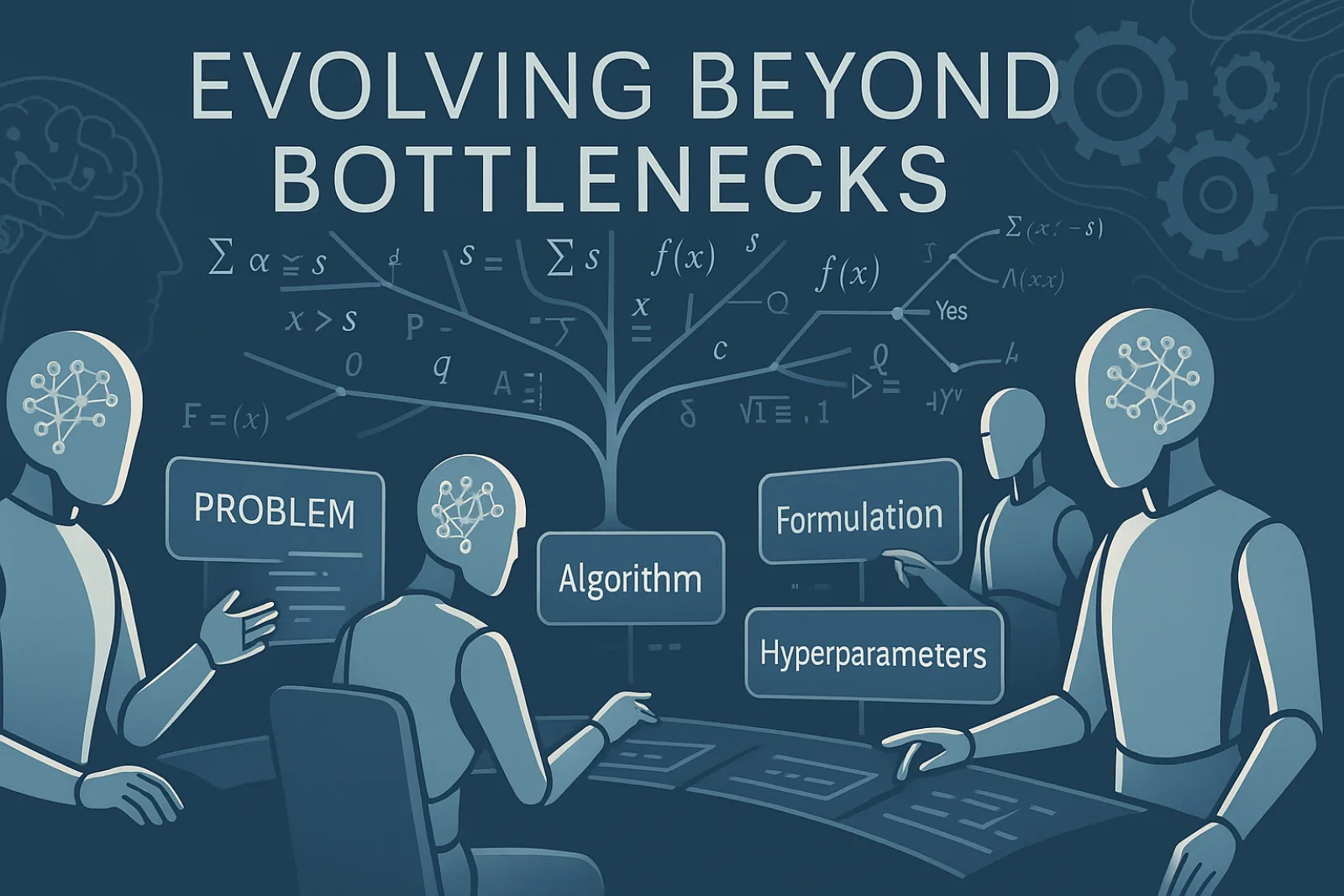
The authors formalise the search space as four connected layers:
| Layer | What it contains | Business version of the problem |
|---|---|---|
| Problem space | Natural-language or multimodal descriptions of real-world tasks | “What are we actually trying to improve?” |
| Formulation space | Mathematical representations, constraints, objectives, variables | “What model captures the trade-off without lying too much?” |
| Algorithm space | Solvers, heuristics, gradient methods, branch-and-bound, scheduling policies | “How do we search for a good answer?” |
| Hyperparameter space | Step sizes, tolerances, regularisation terms, solver settings | “Which settings keep the method from behaving like a caffeinated intern?” |
This framing is the paper’s first important move. It shifts attention away from “Can an LLM solve this equation?” and toward “Can an agentic system navigate the workflow that normally surrounds the equation?”
That is a much better question.
The proposed mechanism is a search loop, not a chatbot with a solver badge
The paper’s mechanism-first argument is simple enough to state and difficult enough to implement: use foundation agents as intelligent generators inside an evolutionary search process.
A foundation model alone can produce ideas, code, modelling suggestions, and tuning rules. That is useful, but dangerous. It may also produce elegant nonsense, which is still nonsense, only wearing a nicer suit. The authors therefore describe an agent architecture with four modules:
| Agent component | Role in the workflow | Why it matters |
|---|---|---|
| Memory | Stores recent attempts and longer-term patterns across runs | Prevents the system from rediscovering the same bad idea every afternoon |
| Reasoning | Checks logic, constraints, feasibility, and mathematical consistency | Tries to keep creativity from drifting into hallucination |
| World modelling | Simulates or approximates how problem conditions may evolve | Helps evaluate candidate strategies before expensive deployment |
| Action | Calls tools, modifies code, invokes solvers, changes formulations or parameters | Turns high-level suggestions into executable experiments |
The evolutionary layer then gives this agentic system a disciplined search process. Instead of asking the model for “the answer”, the workflow maintains populations of candidate solutions. Different “islands” explore different directions. Diversity preservation prevents the search from collapsing too early onto one fashionable but mediocre approach. Selection pressure keeps useful candidates alive. The foundation agent observes what is working and proposes new variants.
This is the key mechanism:
- Generate candidate formulations, algorithms, or tuning rules.
- Evaluate them against formal metrics and human preferences.
- Preserve promising and diverse candidates.
- Feed results into memory.
- Ask the agent to generate better variants.
- Repeat.
The business analogy is not “hire an AI optimizer”. It is closer to building an automated R&D loop around your optimization pipeline.
That distinction matters. A chatbot answers. A workflow experiments.
Human feedback is steering, not decoration
One useful part of the paper is its insistence that human evaluation remains inside the loop. Traditional evolutionary methods often depend on predefined fitness functions. That works when the goal is cleanly measurable. Real operations are less polite.
A scheduling system may maximise utilisation while creating maintenance nightmares. A logistics optimiser may reduce kilometres travelled while producing driver rosters that cause resignations. A cloud placement policy may improve average resource allocation while creating unacceptable tail-risk under burst workloads. The spreadsheet says yes. The business says please stop.
The proposed workflow incorporates human-centred evaluation, including pairwise comparisons between candidate solutions. This allows domain experts to express preferences that are hard to formalise at the beginning: interpretability, maintainability, operational stability, compliance acceptability, and tolerance for edge-case failure.
That is not a minor user-interface feature. It is part of the optimization problem.
The paper positions this as complementary to AutoML. AutoML typically searches within predefined model and hyperparameter spaces. Evolutionary agentic optimization is meant to work when the formulation itself may need to change. In other words, AutoML is strong when the menu is fixed. This proposal is aimed at situations where someone is still arguing about what should be on the menu.
The VM scheduling case tests algorithm design, not the whole thesis
The first case study focuses on virtual machine scheduling in cloud computing. Importantly, the authors narrow the experiment: they fix the problem formulation and hyperparameter settings, then use the workflow to search the algorithm design space. This is not a full test of problem-formulation automation. It is a focused test of whether an agentic evolutionary process can discover a better scheduling heuristic.
The problem is modelled as an online vector bin-packing task. Each virtual machine request requires resources such as CPU and memory. The scheduler must place requests onto machines efficiently. The baseline is BestFit, a traditional heuristic that selects the server with the highest current allocation rate.
The reported metric is scheduling length, defined as the total number of virtual machines processed by the cluster over a given capacity. Higher is better.
| Scenario | VM size | BestFit | NewAlgorithm | Interpretation |
|---|---|---|---|---|
| Train | 50 | 1386.8 | 1526.1 | About 10.0% higher scheduling length |
| Test | 30 | 566.9 | 572.6 | About 1.0% higher |
| Test | 100 | 3811.5 | 3874.9 | About 1.7% higher |
| Test | 150 | 6256.2 | 6318.2 | About 1.0% higher |
| Test | 200 | 8366.5 | 8447.9 | About 1.0% higher |
This is main evidence for the algorithm-design part of the thesis. The training scenario shows a meaningful gain. The transfer scenarios show smaller but consistent gains over BestFit.
The correct interpretation is neither “small gains, who cares?” nor “AI revolution confirmed”. In cloud scheduling, even one percentage point can matter if the workload is large and the cost base is enormous. But the experiment compares against one traditional heuristic, not against every strong industrial scheduler, reinforcement-learning policy, or hand-tuned production system. The paper uses this case to demonstrate possibility, not to settle the scheduling literature.
The training curve in the paper is best read as implementation evidence: it shows that the evolutionary process can progressively improve generated algorithms over iterations. It is not a separate thesis about universal generalisation. The more modest point is enough: the workflow can automate a kind of heuristic search that normally consumes specialist engineering time.
The ADMM case tests tuning policy design, and the evidence is more revealing because it is uneven
The second case study is more mathematically interesting. It focuses on ADMM, the Alternating Direction Method of Multipliers, a widely used method for structured convex optimization. ADMM performance is sensitive to its penalty parameter. Conventional implementations may use a fixed parameter, while expert-designed adaptive schemes adjust it based on primal and dual residuals.
The authors again narrow the search. They fix the problem formulation and algorithm design, then use the agentic workflow to search for an adaptive hyperparameter tuning criterion. The resulting method is called NewADMM.
The paper reports iteration counts required to reach the same tolerance across eight LibADMM applications:
| Problem | ADMM-expert | NewADMM | What changed |
|---|---|---|---|
| L1 | 227 | 60 | Large reduction |
| Elasticnet | 229 | 12 | Very large reduction |
| L1R | 180 | 179 | Almost unchanged |
| ElasticnetR | 250 | 24 | Large reduction |
| RPCA | 94 | 20 | Large reduction |
| LRMC | 83 | 122 | Worse |
| LRR | 198 | 3 | Very large reduction |
| RMSC | 116 | 24 | Large reduction |
This is the most important table in the paper because it resists lazy storytelling. NewADMM is much better on most reported tasks. It is almost identical on L1R. It is worse on LRMC. That is precisely what one should expect from an automated search process operating over problem-dependent tuning rules.
The result does not say “agents discover universally superior algorithms”. It says agent-generated tuning criteria can materially improve iteration efficiency on many tasks, but transfer and robustness still need serious scrutiny.
The paper then reports a generalisation test. Criteria optimised on L1 and Elasticnet are transferred to other LibADMM tasks without further fine-tuning. Across the listed transfer cases, NewADMM again uses fewer iterations than the expert scheme, though the magnitude varies. This table is best read as a robustness or transfer test, not as a second independent benchmark suite. It supports the claim that the learned tuning criteria are not purely memorising one task, but it does not prove broad generalisation across industrial convex optimisation workloads.
That distinction is not academic fussiness. It is what separates an engineering signal from a sales deck.
The paper’s real contribution is workflow design
The temptation is to judge the paper by the two case studies alone. That would underread it.
The stronger contribution is the proposed workflow architecture. The authors are trying to unify several things that usually sit in separate boxes:
| Existing approach | What it automates well | What it usually does not cover |
|---|---|---|
| AutoML | Model and hyperparameter search inside predefined ML pipelines | Reformulating general optimization problems |
| Learning to Optimize | Learned update rules for particular problem families | Broad problem understanding and domain-specific formulation |
| Meta-optimization | Adaptation across related tasks | Open-ended formulation and algorithm generation |
| Automatic algorithm configuration | Parameter tuning within a known algorithmic space | Creating new algorithmic components or changing the formulation |
Evolutionary agentic workflows aim to cover more of the pipeline: problem interpretation, formulation, algorithm design, hyperparameter tuning, tool execution, evaluation, and iteration.
That breadth is also the risk. The wider the workflow, the harder it becomes to verify. A solver parameter can be benchmarked. A new formulation can be wrong in a much more interesting and expensive way.
The paper’s mechanism therefore has to be understood as a layered system. At the bottom are tools and solvers. Above that are candidate algorithms and parameter rules. Above that are formulations. Above that are human preferences and operational constraints. The agent does not replace those layers. It moves between them.
For companies, this is the useful mental model: do not ask whether an AI system can “do optimization”. Ask which part of the optimization workflow it can search, test, and document better than your current process.
What businesses can safely infer
The paper directly shows two preliminary cases: an agent-generated scheduling heuristic beating BestFit in the reported VM placement scenarios, and an agent-generated ADMM tuning rule reducing iteration counts on most listed LibADMM tasks.
Cognaptus infers a broader but bounded business relevance: agentic workflows may reduce the cost of exploring optimization alternatives when expert time is scarce and the solution space is messy.
| Business use case | What the workflow could automate | Practical value | Boundary |
|---|---|---|---|
| Cloud resource allocation | Generate and test placement heuristics | Better utilisation experiments without months of manual heuristic design | Must compare against strong production baselines, not only simple heuristics |
| Logistics and scheduling | Explore alternative formulations and dispatch rules | Faster adaptation when demand patterns shift | Human constraints and labour rules must be encoded and audited |
| Solver configuration | Tune tolerances, penalties, and adaptive rules | Lower iteration counts and faster runtimes | Mathematical guarantees may not transfer |
| Industrial planning | Convert operational descriptions into candidate models | Reduces dependency on scarce modelling specialists | Formulation errors can produce confidently wrong plans |
| Internal optimization R&D | Maintain memory of tried approaches and failed configurations | Avoids repeated experiments and improves organisational learning | Requires disciplined experiment tracking and governance |
The most attractive near-term use is not full autonomy. It is assisted search.
A company with a mature operations team could use this workflow to generate candidate formulations, test solver configurations, produce heuristic variants, and document why certain approaches failed. The human expert then spends less time doing mechanical trial-and-error and more time judging whether the proposed model actually matches the business.
That is a better division of labour. It is also less theatrical, which is usually a sign of sanity.
The practical boundary: proofs, inference cost, and scale
The paper is unusually clear that the proposal has major limitations. Three matter most.
First, theoretical verification is not built in. In optimization, convergence properties, feasibility, and optimality conditions are not academic ornaments. They are the difference between a method that can be trusted and a method that merely looked good on a test run. The authors suggest future integration with proof assistants such as Lean4, but that is future work. Until then, agent-discovered algorithms should be treated as candidates requiring formal or empirical validation.
Second, inference cost can become a barrier. Evolutionary workflows call models repeatedly. If each iteration involves foundation-model reasoning, code generation, evaluation, and feedback, the cost structure can become awkward. This is especially true when the operational gain is marginal or when solution evaluation itself is expensive. Quantisation, distillation, and smaller models may help, but they do not remove the need for cost accounting.
Third, scalability is unresolved. The paper argues that the workflow is heuristic-focused and not inherently limited by problem size. Fair enough. But evaluating candidate solutions on huge industrial instances can become the real bottleneck. A workflow that generates clever ideas faster than the business can test them is not automated intelligence. It is an idea sprinkler.
There is also a quieter limitation: benchmark choice. The VM scheduling case compares against BestFit. The ADMM case uses LibADMM tasks and an expert adaptive scheme. These are useful demonstrations, but they are not enough to claim industrial superiority. Production environments bring noisy data, shifting objectives, legacy systems, compliance constraints, and failure modes that do not fit neatly into a table.
How to adopt the idea without embarrassing yourself
A sensible company would not deploy this as a free-roaming optimization agent with write access to production systems. That would be brave in the way jumping off a roof with a spreadsheet is brave.
A safer adoption path looks like this:
| Stage | Deployment pattern | Human role | Go/no-go criterion |
|---|---|---|---|
| 1. Offline exploration | Agent generates formulations, heuristics, and tuning candidates on historical data | Experts review feasibility and reject nonsense | Does it rediscover known good methods and find plausible variants? |
| 2. Shadow benchmarking | Candidate methods run beside existing systems without operational control | Operators compare results and edge cases | Does it improve target metrics without unacceptable side effects? |
| 3. Constrained pilots | Agent-generated policies are deployed in bounded settings | Humans approve changes and monitor failures | Are gains stable under live variation? |
| 4. Governed automation | The workflow proposes and tests changes continuously | Experts set constraints, audit changes, and approve high-impact shifts | Does the system improve over time without governance debt? |
The paper’s framework is strongest in stages one and two. That is where automated search can create value without pretending to be a certified optimization oracle.
The conclusion: the expert becomes a search architect
The most useful reading of this paper is not “AI replaces optimization experts”. That is the easy misconception, and like many easy misconceptions, it is mostly useful for conference panels and LinkedIn fog machines.
The better reading is this: optimization expertise may move up a level.
Instead of manually crafting every formulation, heuristic, and parameter rule, experts may increasingly design the search environment: what spaces can be explored, what constraints are inviolable, what tools can be called, what metrics matter, what evidence is sufficient, and when a candidate must be rejected.
That is a meaningful shift. It turns optimization from a narrow craft bottleneck into a managed experimental system. The expert does not vanish. The expert becomes the person who decides where the machine is allowed to search, how it proves progress, and what counts as operational truth.
The paper does not prove that this future is ready. It does show why the old workflow is creaking. When real-world optimization depends on a tiny number of people manually navigating problem, formulation, algorithm, and hyperparameter spaces, the bottleneck is not just technical. It is organisational.
Evolutionary agentic workflows offer a plausible way to widen that bottleneck. Not by making optimization effortless. By making the search itself more systematic, more reusable, and less dependent on one overbooked expert with a solver manual and a haunted calendar.
Cognaptus: Automate the Present, Incubate the Future.
-
Wenhao Li, Bo Jin, Mingyi Hong, Changhong Lu, and Xiangfeng Wang, “Optimization Problem Solving Can Transition to Evolutionary Agentic Workflows,” arXiv:2505.04354, 2025. ↩︎