TL;DR for operators
The AI market is not choosing between “one model to rule them all” and “a thousand specialist flowers blooming politely in a procurement spreadsheet.” It is choosing by workload.
GPT-4o’s native image generation matters because it folds visual production into the same conversational workspace where users already brainstorm, rewrite, code, and revise. That is not just a model upgrade. It is a distribution upgrade. The GPT-4o system card describes an omni model trained across text, vision, and audio, with stronger multimodal capability and lower API cost than GPT-4 Turbo in OpenAI’s own framing.1 OpenAI’s March 2025 image-generation release then pushed that logic into visual work: generate, critique, revise, and regenerate without leaving the chat.2
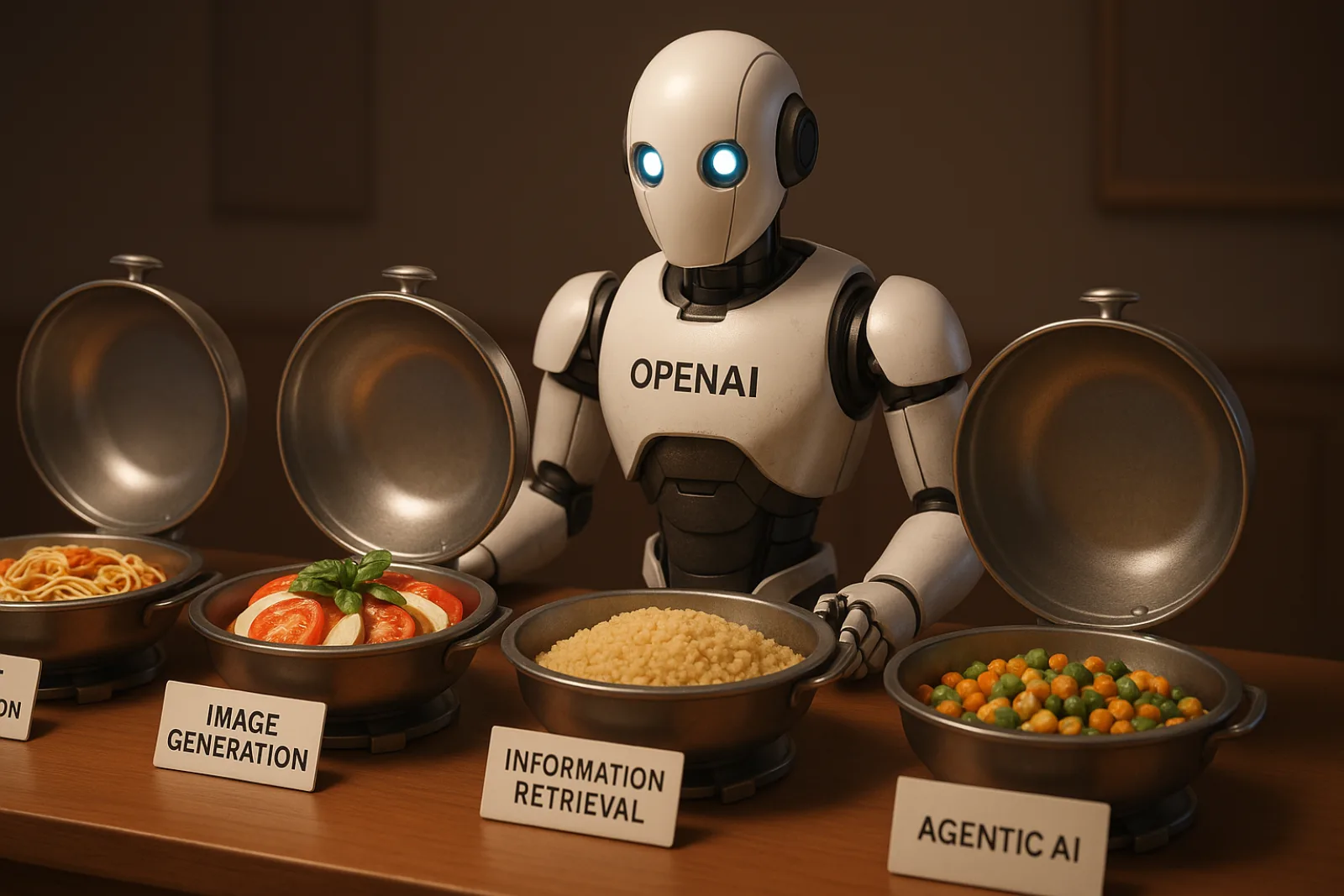
For casual users and many small teams, this is brutally effective. A bundled model does not have to beat every specialist tool at every task. It only has to be good enough, always available, and cheaper than maintaining a drawer full of separate subscriptions. The buffet wins because nobody wants to queue five times for dinner.
But specialty models are not dead. They survive where the buyer is not purchasing “AI magic” but solving a constrained operating problem: lower inference cost at scale, domain-specific reliability, local deployment, compliance, latency, privacy, or policy flexibility. The business lesson is not “pick the best model.” It is “route each workload to the model whose economics and risk profile match the job.” Revolutionary, yes. Almost like software architecture existed before demo videos.
The familiar pain is subscription sprawl
A marketing manager wants product mock-ups. A founder wants pitch-deck visuals. A developer wants UI variations. A student wants diagrams. In the old workflow, each job pointed to a different tool: one model for text, another for images, another for code, another for presentation polish, and possibly a fifth for the privilege of making the first four disagree with each other.
GPT-4o’s image-generation upgrade attacks that mess directly. The improvement is not simply that images look better. The sharper point is that image generation becomes conversational. A user can describe a visual, ask for changes, reuse earlier context, refine the copy on the image, and keep iterating without exporting half-finished assets between tools. That is the kind of small friction reduction that looks unimportant in a benchmark and murderous in a market.
The likely misconception is that the best standalone image model should win the image-generation market. Sometimes it will. But consumer AI markets do not reward isolated excellence as cleanly as enthusiasts imagine. They reward the product that is accessible at the moment of intent. The best camera is the one you have with you; the best model is increasingly the one already sitting in the chat window.
GPT-4o changed the bundle, not merely the picture quality
OpenAI’s 4o image-generation release emphasised photorealism, instruction following, text rendering, and image editing inside ChatGPT.2 Those capabilities matter, but the strategic move is bundling. Text, image, coding help, reasoning assistance, and iterative editing become parts of one subscription experience.
That changes the competitive question. Midjourney can still be excellent for stylised visual exploration. Stable Diffusion remains attractive for users who want local control, custom pipelines, or open model ecosystems. Adobe Firefly has an obvious home inside professional creative workflows. Google’s image models remain technically serious. But the buyer’s question shifts from “Which tool produces the best image in a controlled comparison?” to “Which tool lets me finish the job with the least coordination cost?”
That difference sounds mundane because it is. Most market power is mundane after the press release fades.
The integrated model has three advantages:
| Advantage | What it changes | Business consequence |
|---|---|---|
| Context continuity | The model remembers the surrounding task, not just the image prompt | Less prompt rewriting and fewer handoffs between tools |
| Subscription consolidation | One monthly payment covers multiple creative and analytical jobs | Standalone tools must justify incremental spend |
| Interface familiarity | Users already know where to ask, revise, and export | Adoption grows through habit, not training programmes |
The last point is the quiet killer. A technically superior tool that requires users to leave their default workspace must be substantially better, not slightly better. Slightly better is a feature. Substantially better is a reason to change behaviour.
“Winner takes most” is a stronger claim than “winner takes all”
A dominant general-purpose model can absorb a large share of mainstream demand without eliminating specialist competitors. This is the pattern that matters.
In consumer AI, “good enough plus integrated” is often more dangerous than “best in class but separate.” The casual user does not run formal evaluations. They compare outcomes against effort. If GPT-4o can create a usable product image, rewrite the caption, generate landing-page copy, and adjust the colour palette in the same thread, then a specialist image subscription starts to look like a tax on enthusiasm.
The same logic applies to small businesses. A founder may not care whether a standalone model wins a narrow image benchmark if the bundled model can create social posts, explain ad variants, draft email copy, and generate acceptable visuals under one plan. In that market, breadth is not a compromise. Breadth is the product.
But this does not make GPT-4o a universal replacement. It makes it the default layer for broad, low-to-medium-risk work. Defaults are powerful because they capture demand before alternatives are even considered. Specialist tools then have to compete where default convenience breaks down.
The specialist market begins where “good enough” becomes expensive
There are four defensible zones for specialty models. They are not equally glamorous. Glamour is not the point. Margin rarely asks to be photographed.
| Zone | Why the general model weakens | What specialty providers can sell | Boundary |
|---|---|---|---|
| High-volume API workloads | Per-call costs compound at scale | Cheaper inference, caching, distillation, routing, open deployment | Only works if quality loss is acceptable |
| Regulated or expert domains | Generic fluency is not domain assurance | Domain evaluation, terminology control, auditability | Requires evidence, not “trained on industry data” theatre |
| Sensitive data environments | Cloud routing may violate policy or risk appetite | Local deployment, private fine-tuning, controlled logs | Operational maturity matters more than model branding |
| Creative or workflow-specific niches | Integrated tools may be too general | Style systems, asset libraries, professional integrations | Must be embedded in the user’s actual workflow |
The specialist provider’s mistake is to argue, “Our model is better.” Better at what, under what cost, with what evidence, and for whom? The buyer does not purchase benchmark purity. The buyer purchases reduced failure.
API-heavy users care less about elegance and more about unit economics
For individuals, a bundled subscription feels like abundance. For API-heavy businesses, abundance has a meter attached.
A retail platform generating thousands of product mock-ups, a game studio rendering concept variations, or an e-commerce tool producing personalised ad creatives will not evaluate models like a casual ChatGPT user. At scale, cents become architecture. Latency becomes conversion. Rate limits become operations. Repeated calls become a finance meeting, which is where joy goes to be reformatted.
This is where smaller, cheaper, or open models remain relevant. They may not be the most impressive general-purpose system, but they can be the right component. DeepSeek-R1’s release is important in this context because it showed that open reasoning-focused models could approach frontier-model performance on selected reasoning tasks while offering distilled variants for different deployment sizes.3 The business implication is not that every company should replace GPT-4o with DeepSeek-R1. That would be a charmingly reckless procurement policy. The implication is that model routing becomes rational.
Use the strongest integrated model for ambiguous, high-context, user-facing work. Use cheaper specialised or distilled models for repeated narrow tasks where output quality can be tested automatically. Use local models where data control dominates convenience. The winner is not one model. The winner is the routing layer.
Domain models survive when error costs are asymmetric
General models are excellent at sounding competent. In medicine, law, finance, and engineering, sounding competent is not the same as being useful. Occasionally, it is the expensive opposite.
Medical AI illustrates the distinction. Med-PaLM and Med-PaLM 2 were designed and evaluated for medical question answering, with the original Med-PaLM reported as the first model to exceed a passing score on USMLE-style MedQA questions.4 That does not make such systems ready to replace clinicians. It does show why domain-specific evaluation matters. The model is judged against a domain task, with domain risks, in domain language.
The same pattern holds elsewhere:
- In legal workflows, citation format, jurisdiction, and procedural accuracy matter more than conversational charm.
- In finance, a plausible explanation that misstates a filing is not “creative”; it is a liability with adjectives.
- In industrial design, visual beauty is secondary if the output ignores mechanical constraints.
- In healthcare, the cost of hallucination is not an amusing screenshot.
Specialist models and specialist systems can justify themselves when they reduce a known class of error that the general model is not designed to minimise. That is a stronger proposition than “we fine-tuned on proprietary data,” the enterprise AI equivalent of saying the soup has a secret ingredient.
Open and local models are procurement tools, not ideological mascots
Open models are often discussed as if the market were a personality test: closed platforms for convenience people, open models for freedom people. In business, the split is more practical.
Local or self-hosted models become attractive when the organisation needs control over data flow, logging, model behaviour, latency, or jurisdiction. Hospitals, banks, defence contractors, and public-sector agencies may not be able to send sensitive material into a third-party cloud service, even when the model is better. The question is not whether the general model is impressive. It is whether the deployment path is acceptable.
The Llama, Mistral, Qwen, and DeepSeek ecosystems matter because they make model ownership and adaptation more plausible. That does not mean local deployment is automatically cheaper. It can be more expensive once infrastructure, security, monitoring, and maintenance are counted. The right comparison is not subscription price versus zero. Open-source software remains mysteriously fond of engineers, GPUs, and incident response.
The operational test is simple: if control lowers risk more than hosting raises cost, local deployment has a case. If not, the company may simply be cosplaying sovereignty while building a worse helpdesk.
The grey market exists, but it is not a respectable moat
Some demand will move toward less restrictive tools. Adult content, controversial political persuasion, impersonation-adjacent media, and other policy-sensitive use cases do not disappear because mainstream providers refuse them. They move to smaller models, local deployments, or fringe platforms.
That matters analytically because it prevents a naïve “one model captures everything” view of the market. Content policy is a segmentation force. The more visible and regulated the dominant platforms become, the more some demand leaks into less governed systems.
But leakage is not the same as a defensible business strategy. A company can make money serving off-menu demand, but it inherits legal, reputational, payment, distribution, and platform risks. Investors and enterprise buyers should not confuse policy arbitrage with durable product-market fit. The shadows are real. They are also, inconveniently, shadows.
The evidence supports bundling, but not monopoly destiny
A reasonable reading of the evidence is narrower than the loudest version of the argument.
What the evidence directly shows: GPT-4o is designed as an omni model spanning multiple modalities, and OpenAI’s image-generation release brings stronger visual creation into the same ChatGPT experience.1 Early empirical work on GPT-4o image generation also frames it as part of a shift toward unified generative architectures, while noting that its architectural details remain unpublished and that strengths and weaknesses vary across task categories.5
What Cognaptus infers: bundling will capture a large share of casual and semi-professional demand because integration reduces switching costs, subscription sprawl, and workflow fragmentation. The model that handles “enough of the job” inside the default interface becomes very hard to dislodge.
What remains uncertain: whether OpenAI can maintain the price-performance curve, whether competitors can differentiate through workflow depth, whether open models will keep compressing inference costs, and whether regulatory or copyright pressure changes what mainstream image systems can safely offer.
That uncertainty is not a footnote. It defines the strategy.
A practical model-selection rule for AI buyers
The operator’s mistake is to choose models by reputation. The better approach is to classify workloads.
| Workload type | Default choice | Why |
|---|---|---|
| Ambiguous creative work | Integrated general model | Context and iteration matter most |
| Repeated narrow generation | Cheaper specialised or distilled model | Unit economics dominate |
| Regulated expert task | Domain-evaluated system | Error cost and auditability matter |
| Sensitive internal data | Local or private deployment | Control outweighs convenience |
| Professional creative pipeline | Workflow-native specialist tool | Integration into production software matters |
| Experimental frontier task | Best available frontier model | Capability ceiling matters more than cost |
This framing avoids the childish version of the debate. GPT-4o does not need to kill Midjourney, Stable Diffusion, Firefly, Imagen, DeepSeek, or domain-specific AI systems. It only needs to become the default for the largest pool of general demand. That is already a large prize.
The rest of the market then fragments around constraints. Cost. Compliance. Control. Style. Latency. Domain accuracy. Deployment politics. The buffet has a main station, yes. But the serious money often hides in catering, procurement, and kitchen logistics. Very glamorous, naturally.
The business value is in routing demand, not worshipping models
The next phase of AI adoption will not be organised around brand loyalty to a single model. It will be organised around model portfolios. The strongest companies will treat frontier models as one layer in a broader system: excellent for high-context, high-ambiguity work, but not automatically optimal for every repeated task.
For AI product builders, the lesson is sharper. Do not compete with GPT-4o by offering a slightly better generic chatbot or a slightly prettier generic image generator. That road leads directly into the platform’s digestive system. Compete where the platform is structurally weak: workflow ownership, domain-specific guarantees, deployment control, cost compression, or proprietary user context.
For enterprise buyers, the lesson is less romantic but more useful. Stop asking which model is “best.” Ask which failure mode is most expensive. Then choose the model, architecture, and governance layer that reduce that failure at the lowest sustainable cost.
Conclusion: the main course is not the whole meal
GPT-4o’s image-generation upgrade is a market signal. The general-purpose AI platform is becoming more capable, more convenient, and harder for standalone tools to ignore. For mainstream users, the appeal is obvious: one chatbox, many outputs, fewer subscriptions, less friction.
That creates a winner-takes-most dynamic. Not winner-takes-all. The difference matters.
Specialty models still sell when they solve problems the buffet cannot: cheaper scale, stricter control, domain reliability, workflow depth, private deployment, or policy flexibility. Their future is not in being generically impressive. It is in being specifically necessary.
The supermodel may dominate the menu board. But the profitable kitchens will still know exactly which dish they are cooking, who is paying for it, and what happens if it comes out wrong.
Cognaptus: Automate the Present, Incubate the Future.
-
OpenAI, “GPT-4o System Card,” arXiv:2410.21276, 2024. https://arxiv.org/abs/2410.21276 ↩︎ ↩︎
-
OpenAI, “Introducing 4o Image Generation,” March 25, 2025. https://openai.com/index/introducing-4o-image-generation/ ↩︎ ↩︎
-
DeepSeek-AI et al., “DeepSeek-R1: Incentivizing Reasoning Capability in LLMs via Reinforcement Learning,” arXiv:2501.12948, 2025. https://arxiv.org/abs/2501.12948 ↩︎
-
Karan Singhal et al., “Towards Expert-Level Medical Question Answering with Large Language Models,” arXiv:2305.09617, 2023. https://arxiv.org/abs/2305.09617 ↩︎
-
Sixiang Chen et al., “An Empirical Study of GPT-4o Image Generation Capabilities,” arXiv:2504.05979, 2025. https://arxiv.org/abs/2504.05979 ↩︎